Preparing Your First Time Student for the Fall

mom and daughter2I’d like to organize this post around five Q & As:

1.  Why should parents of rising preschoolers or kindergarteners be thinking about this now?

If no child or adult in your home is experiencing anxiety about the pending school year little preparation may be needed. However, if anyone is nervous a little preparation may increase comfort and reduce drama come the big day. When in doubt, it’s usually better to prepare, when that isn’t warranted, than the other way around.

2.     What are some things parents can do in the home to help prepare their young children?

The short answer: play and read together. The playing could be things like role playing (e.g., one of my fondest parenting memories is my eldest bossing me about the classroom, as my teacher, when we would play this game). It could also be drawing about the pending school year. Kids often use play to acclimate themselves to developmental challenges.

The reading could be acquiring related books on the topic and reading them to dadandsonyour child, maybe following such up with a discussion. I find the books at magination press tend to be helpful while I like how the scaredy squirrel books treat anxiety in general.

3.     Are their any field trips that can be helpful?

Probably the most useful thing you could do would be to take a trip, with your child, to the classroom; even better yet would be to meet the teacher and to talk about what the school year will be like. Many preschool and elementary schools are willing to make such a service available in August. If not, even driving to your child’s school and walking around it, or in it, can be helpful. Also, if your child will be taking a school bus for the first time, it can be a good idea to get permission to sit in a bus for a few minutes. (Meeting his or her actually school bus driver may not be possible. But, if it is, that could be a good idea as well.)

4.     Any other preparation that can be done?

The first preparation is an anti-preparation: avoid reassurances about the school year. But, if you must reassure, try not to overdo it. A reassurance indicates that there is something potentially threatening at hand. If you came to my office and I said to you: “don’t worry about getting lice here as I keep my office very clean” can you imagine how uncomfortable you could start to feel? A well intended, but sometimes unhelpful reassurance, could be something like “Don’t worry about going to school this year. You’re going to love it.” Instead, it might be better to say something like: “Guess what, you’re going to get to make lots of new friends in a few weeks!” But, you don’t want to oversell, less you create the impression that your pushing a lemon.

character students lined up in desksIt can also be fun to collaborate on school clothes and supplies. This needn’t break your bank. Just whatever you can afford. I think it’s also good to segue to your school time sleep routine the week before. (I’ve written multiple blog entries on sleep. Just enter “sleep” in the search engine above.)

5.     Will you be offering any other advice on this topic?

Yes. In the near future I’m going to do a blog entry on how to avoid separation drama on the first day of school. So, stay tuned.


The Serenity Prayer and Parenting

prayingThis is a well-known version of the Serenity Prayer:

God, grant me the serenity to accept the things I cannot change,
The courage to change the things I can,
And wisdom to know the difference.

Let me make my points through six questions:

1. Are you suggesting that one need be religious to be a good parent?

No, I’m not suggesting that. While practicing a religion is correlated with a wide array of good health outcomes, one can be an atheist and still benefit from adhering to the psychological principle imbued within this prayer.

2. What is the psychological principle?

Want to burn a person out? The formula is simple: give that person a sense of responsibility for an important outcome; then make sure s/he doesn’t have the power to achieve it. As the importance of the outcome rises, and control goes down, burnout rises. Sounds silly for someone to allow himself or herself to fall prey to this doesn’t it? Yet, we cooperate with this sort of an agenda all the time. We do this in our vocations (e.g., serving more people with fewer resources) and in our personal lives (e.g., trying to get another human to stop a self-destructive habit). There’s a reason why so many recovery programs lean heavily on this prayer.

3. How is this related to parenting?

As I’ve routinely noted in this blog, we parents love our kids so much it makes black mom with kids, white backgroundus crazy people. When our kids hurt we hurt worse. We also are very focused on procuring the best outcomes for our kids. This great love of ours, in combination with our mighty concern for our kids’ outcomes, can cause us to try to control things that are either outside of our control or which would be better left to the control of our kids or those serving them (e.g., teachers, coaches), especially as they age.

4. What are some signs that a parent might be trying to control things not within his or her control?

Tension and frustration are often experienced. Of course, experiences of tension and frustration are not exclusive to these moments. But, if I’m trying to control things not within my control, I can get myself pretty worked up. My kids will also either tremble in my wake or storm the gates of my authority. Others trying to serve my kids will also often manifest some combination of finding me odd, trying to avoid me, or joining the charging of the gates.

5. How do you distinguish between not trying to control uncontrollable things and disengagement or laziness?

The prayer indicates that this can be tricky, which is why there is the request for wisdom. For my part, I find that those parents who are at risk to be over controlling don’t often have it within them to be disengaged or lazy.

spiritual man As a professor, I see some students who over study. Sometimes this causes them to fret needlessly. As I try to get them to throttle back a little, I’ll say things like “y’know, someone like you is never going to just dial it in. You may burn out but you’re never going to rust out.” I think it’s the same thing with we parents. There are those of us who are disposed towards micromanaging (the burn out crowd) and those of us who are disposed to dialing it in (the rust out crowd). (By the way, does the rust out crowd even read parenting blogs?). So, if you’re in the former group, I don’t really think you have to worry too much about being disengaged and lazy when it comes to parenting. It’s just not in ya 😉

6. Any closing advice?

Just ask yourself if this thing you’re fretting over is really within your control. And, if it is, might it better to relinquish it to someone else? If the control is yours and it’s best to have at it, go forth and do well young lady/man! If it isn’t, try letting go. In my experience, if you let go of something that warrants it, there’s often an  internal confirmation you feel that you’re doing the right thing; this may or may not be accompanied with a feeling of peace (as your child’s outcome is still at issue), but it’ll often feel, somehow, someway, like it’s the right thing to do (and I speak as someone who owns a t-shirt that says “micromanager”).

Parents of Teens: Do You Actually Give People Your Home Phone #?!

This week my youngest turns 13, which now means that I live with 3.0 teenagers, and will do so until 8/14, at which point my eldest will go off to college.

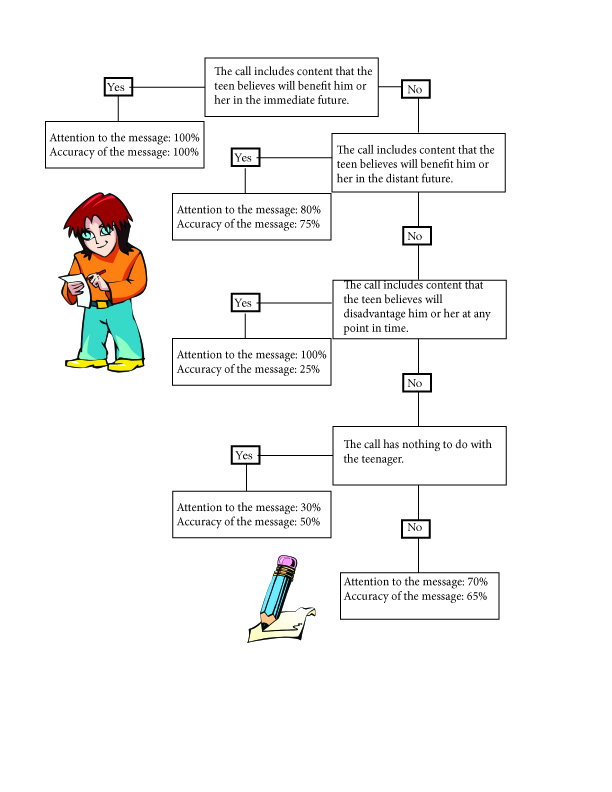
In the spirit of that reality, I’m blogging today about the odds of getting an accurate message delivered to you, when a teenager has taken the message. As you examine the illustration below, please note that this is dependent on the caller having had the good sense to make sure that your teen wrote down the message. Without that, the numbers would be much lower 😉

teens and phone messages

Elements of Quality Mental Health Treatment for Youth

billboard2 copyI find that many parents have little idea what to expect when taking their child or teen for mental health services. In my last blog, I described elements of a good mental health evaluation for a child or teen. In this entry I will describe elements of quality outpatient mental health treatment. (Please keep in mind that some of these elements may not be present in your child’s or teen’s care but s/he may still be receiving good treatment.)

√ A diagnostic impression is shared. The insurance company is usually getting this information, so you should too. More importantly, having these words allows you the opportunity to educate yourself about the condition(s).

√ The clinician has discussed how he or she arrived at the diagnostic formulation and the the primary scientific findings pertaining to such (e.g., causes, prevalence, outcomes).

√  The clinician shares specific information regarding which treatment(s) is/are   therapy etchingrecommended. This should include giving you the name of what each treatment is called; again, this allows you to educate yourself about the science behind the intervention. The clinician also does well to include, in instances when more than one intervention is recommended, which intervention is treating which problem or diagnosis; a discussion of the prognosis is also usually advisable.

√ The clinician endeavors to answer all of your questions, either at the time that you ask or later, including telling you when the available science does not allow a question to be answered well or thoroughly.

√ The clinician develops measurable treatment goals in collaboration with you and/or your child or teen. These goals need not be (and usually are not) a comprehensive listing of what will be worked on. But, they include signposts that help you to know (1) if the treatment is working and (2) when you are done.

therapy with teen√ The clinician is comfortable with, and even encourages, you and your child or teen to express differences of opinion regarding what s/he is stating or recommending.

√ The clinician follows the agreed upon treatment plan and doesn’t make changes without getting your informed consent.

√ The clinician tracks progress, keeps scheduled appointments, doesn’t take phone calls or check his or her phone during the appointment (unless you’ve agreed to an exception), meets the entire time, remains both pleasant and alert and gives you sufficient notice of any extended vacations or breaks from treatment.

√ You get the sense that the clinician cares about your child or teen and his or her success.

√ You are kept informed about progress. While the clinician may not share information that your child or teen wishes to keep confidential, s/he should keep you informed in general terms. If the treatment is behavioral in focus, it is also commonly recommended to teach you how to coach and reinforce the skills your child or teen is learning.

√ If there are problems at school, the clinician should be available to collaborate with school personnel; sometimes this may warrant attending an in-person meeting at the school.

√ The clinician may recommend things you can do to augment the work (e.g., overwhelmedread a book, attend a support group meeting).

√ The clinician is not shy about bringing up sensitive topics, including if s/he believes that your getting mental health care for yourself could be helpful.

√ Appointments are scheduled at a pace that is consistent with how the treatment is usually prescribed (something you can easily learn yourself with a little leg work).

√ While your insurance company may dictate what is covered and what isn’t, you should never get the sense that the insurance company is dictating what is diagnosed or what treatment(s) is/are being recommended.

Good luck! To find a clinician near you, click here.

What Does a Good Mental Health Evaluation Look Like?

billboard2 copyIn last week’s blog I discussed why the summer can be a great time to get a child or teen a mental health evaluation. This week I will review the elements of a good child or teen mental health evaluation. At the end I will offer a few qualifiers.

(I recently ended a term co-chairing the Pennsylvania Pediatric Mental Health Task Force, a collaboration between the Pennsylvania Psychological Association and the Pennsylvania Chapter of the American Academy of Pediatrics. That task force endorsed the standards I am reviewing here.)

A good mental health evaluation for a child includes the following elements:

• A family interview. “Family” can be legitimately and differently defined across clinicians. For me, it is the youth of concern and his or her parents and stepparents. If the adults cannot be interviewed together (e.g., there is too much resentment) this can be spread across interviews. I find it very difficult to get the relevant information, while building a trusting relationship, in less than 90 minutes. This is an essential part of the evaluation as it is exceedingly difficulty to accurately understand a child’s or teen’s symptoms independent of the context in which that youth resides.

• A youth interview and/or play session. Each child or teen has a great deal of useful line of kidsinformation to share. However, s/he may not be able or willing to do so with his or her parent(s) in the room. This is true even among youth who are not psychologically minded or inclined to cooperate.

• The completion of parent, teacher and child behavior rating scales. These scales allow a clinician to measure whether a youth’s symptoms and strengths are atypical among children or teens of his or her age and sex. The available research also suggests that parents, teachers and kids each possess important, complimentary and unique information about a given youth’s functioning.

• A review of academic records. This includes report cards, state achievement testing and relevant special education or disciplinary records. Sometimes parents believe that the school life is not a problem but records suggest that there are important opportunities for growth there. Moreover, such records can present the clinician with information that allows him or her to develop a more nuanced understanding of a kid (e.g., how often a child is tardy or absent, academic strengths and weaknesses).

defiant boy• A review of any relevant medical, psychological, welfare or forensic records that exist on the youth. I tell families that work with me: “If you’re in doubt regarding whether a document could be important for me to review, include a copy of it.”

• A behavior rating scale that screens for parental wellness. The research and my clinical experience both suggest that the number one complicating factor in mental health treatments for youth is the mental health status of his or her parent(s). (You can find numerous articles on this blog pertaining to the connection between parent and kid wellness.)

I have seven qualifiers for these remarks:

1. Other evaluation tools may also be needed to render a reasonable diagnostic formulation (e.g., psychological testing, medical evaluations, speech and language evaluations).

2. There may be clinical contraindications for doing some of the procedures I have reviewed here. However, if such contraindications exist they warrant discussion.

3. Here’s the elephant in the room: limits on insurance coverage often drive medicalsymbolanddollarsstandards instead of the other way around. Too many times I’ve heard clinicians lament that they do not do what they believe is clinically warranted because an insurance company won’t pay for it. Yes, that can be a harsh reality (actually, a very harsh reality). But, parents (and sometimes the youth too) deserve to hear, from the clinician, what the clinician believes is an advisable evaluation plan. Then the parents can decide, once they are informed regarding the pros and cons of their choices, whether they wish to proceed in a truncated fashion (i.e. what the insurance will cover) or do as the clinician recommends. (For my blog entry on paying for mental health services, click here.)

4. Here’s the elephant’s sidekick: child and teen clinicians are busy people who often have large caseloads (put this statement all in caps for those child clinicians working within agencies). A given child or teen clinician may feel too busy to do an evaluation the like of which I’ve described here. If so, this also deserves a frank discussion so that parents can make their own decision about who to see. I have no problem with a clinician doing a truncated evaluation. I do have a problem with a clinician doing a truncated evaluation without informed consent.

character checking off checkboxes5. A diagnostic formulation can hit the bullseye without all of these elements being included. Heck, if a parent honestly answered my questions for 10-15 minutes, and I were to develop a formulation based only on that interview, I might end up being right a good amount of the time. However, I’d be wrong, or importantly incomplete, in an unacceptable number of instances. This is why due diligence is warranted.

6. The evaluation standards I’ve reviewed here include a cost-benefit analysis. (If that weren’t the case, I’d recommend psychological testing for every child and teen.)

7. A good mental health evaluation on a child or teen will offer a thorough review of his or her strengths. And, this will be a central aspect, not just a preliminary or sidebar feature.

There are numerous other issues I haven’t covered here (e.g., what are the signs that a child might need a mental health evaluation, how can one parent get this done when another is resisting it, what’s a good way to approach a school or teacher about participating). But, you can find these topics addressed either in other blog entries (use the search bar at the top right) or in my parenting book Working Parents, Thriving Families: 10 Strategies that Make a Difference.

Next week I will review methods for active partnering and participation with your child’s or teen’s mental health professional. For now, good luck, and click here for referral information.

Parenting Through Divorce, Part 2

divorce graphic2In last week’s blog entry I set a context for parenting through divorce and reviewed some common parenting traps. This week I will focus on positive parenting practices and offer some qualifiers.

The following can be very helpful to your child as your family adjusts to divorce:

• Having positive conversations with your ex within earshot of your child.

• Offering sincere compliments regarding your ex within earshot of your child.

• Affirming to your child that your ex loves him or her.

• Qualifying or disagreeing with negative statements that your child makes about your ex (see last week’s entry for the rationale).

• Putting your child’s best interests above any feelings of rage or hurt that you Asian mom with kidscontinue to feel towards your ex.

• Keeping your child unaware of any ongoing court battles.

• Making peace with your ex as quickly and as thoroughly as possible. Sacrifices rendered along these lines, as long as you can manage them, are in service of giving your child a precious gift.

• Allowing and welcoming your child to voice feelings of loss pertaining to your ex. This can be very hard to bear but your child will likely appreciate your selflessness across time.

• Allowing your child to talk about, and play through, feelings pertaining to the divorce.

• Providing the your child with methods for coping with the divorce (e.g., readings—for example see the book for kids by Isolina Ricci, a child divorce support group, counseling and so forth).

ethics, awesome• Pursuing your own recovery from the divorce.

I have four qualifiers for this material:

1. Many parents in my practice will say things like “Ok. Fine. But, what if I play by these rules and my ex doesn’t. My child will end up hearing only complaints about me from my ex and only positive statements about him from me. This could cause my child to be turned against me!” I have two responses. First, I’ve found that when you widen the lens across time, instead of only considering the here-and-now, you will find that most kids, or adult children, will be able to tell which parent is acting in a loving fashion versus which parent is acting more out of hurt and anger. Second, I would use your child’s psychologist to help you with this. She or he can be in touch with the other parent and/or help your child to recognize how much your behaviors along these lines are evidence of your now what characterselflessness and love.

2. Sometimes parents challenge: “But, he gets drunk when my child is with him.” “Or, she has sex in common and open areas of the house with her boyfriends while my kids are sleeping in their beds.” Or, fill in the blank with some other potentially abusive or seriously neglectful behavior. The question becomes “how can I allow my child to be exposed to situations like this?” In my experience these situations are sometimes innocent or easily adjusted, while at other times they represent a serious and ongoing problem; it can be almost impossible for you, as the ex, to make an objective determination about which is the case. However, a child psychologist can help you to both understand what is going on and craft a reasonable intervention plan. But, regardless, be reassured that no reasonable adult believes that it is serenity prayer backgroundokay for a child to be subject to abuse or neglect.

3. You want a formula for creating burnout? Insert the following three elements into a person’s life: (a) the notion that a given outcome is very important, (b) the idea that that person is responsible for that outcome and (c) the person does not have the power to significantly affect the outcome. This is why the serenity prayer is so commonly used in recovery programs. If I try to control how my ex parents I am setting myself up for significant stress because such involves an important outcome over which I have very little, if any, control. This is another scenario where a good child psychologist can be very helpful.

4. If you find that you cannot follow these indicators because your feelings of hurt and anger are too great, it would be highly advisable for you to consider starting your own counseling. (This might be a good idea even if you can act with intention.) If research on parenting tells us anything, it is that promoting your own wellness is an act of love towards your child. (I have some searchable databases on my website: www.helpingfamilies.com/referrals.html.)

Every crisis contains both pain and opportunity, with the dosing of opportunity crisis opportunityoften exceeding the dosing of pain. Parenting a child through a divorce usually involves plenty of pain. But, such situations also include opportunities to manifest and model both excellence in parenting and selflessness. There is no way to calculate the incredible value of such manifested love.

Parenting Through Divorce, Part 1

divorce kidBecause of the various ways that families are formed or changed, most children do not reach age 18 living with both birth parents. Quoting a 2005 research brief from the Center for Marriage and Families at the Institute for American Values: “Before they reach the age of 18, a majority of all U.S. children are likely to spend at least a significant portion of their childhoods in a one-parent home.” A significant contributor to this landscape is the fact that almost half of first marriages end in divorce. Therefore, if you find yourself parenting within a divorced family, you’re in a very, very large club. In this week’s and next week’s entries I will focus on this topic. This week I will set a context and describe common undesirable parenting behaviors. Next week I will describe positive parenting strategies.

Divorce can cause some of the deepest wounds that a person can suffer. So, when someone suggests that your ex is still a member of your family, and that finding a way to parent cooperatively is an important goal, your stomach can wrench. Your ex may have cheated on you, abused you, damaged your relationships with others, stolen from you, made you feel worthless or done some other terrible things. Or, your ex may be highly emotionally reactive to you and depressed characterlose his or her mind whenever you open your mouth. In these situations, it’s so easy, and even understandable, to either stay trapped in feelings of hurt and rage or to be highly dismissive of your ex. Moreover, you might deeply begin to question whether your ex should even be allowed to parent, never mind parent your child/children. Such thoughts and feelings are both common and easy to empathize with. After all, these are human reactions to real pain, suffering and alienation. That said, research makes it clear that the two largest predictors of child adjustment following a divorce are 1. How many changes the child needs to endure (with fewer being better) and 2. How well the divorced parents get along.

With a context set, let me share that the following are usually hurtful to a child:

divorce, child in betweenBerating your ex within earshot of your child. Berating your ex outside of your child’s hearing range is also usually not advisable (see below). It sometimes helps to remember that every bullet fired at your ex goes through your child first.

Quarreling with your ex within earshot of your child. Nothing makes a child want to cover his or her ears more than his or her parents arguing. Kids turn up music, put on headphones, leave the house or do whatever they can to avoid hearing these arguments. To them, who is right and who is wrong, and what is being argued about, no matter how important it may be to the adults, is usually not very important.

Allowing your child to say negative things about your ex without challenge. I know this can seem counterintuitive. But, keep in mind that your child likely has an uncanny sense for what pleases you. And, pleasing you may be worth the pain of trashing your ex. For your child this is like sticking a dart into himself or herself. If left unchallenged, your child may end up complaining about your ex to you and vice versa. The resulting wounds can facilitate surprisingly negative outcomes, both now (e.g., depression) and later (e.g., your adult child becoming insincere and chameleon like in relationships).

Expressing non-verbal anger towards the other parent within earshot of divorce graphicyour child. While verbal expressions of anger are often more damaging, this often hurts too. While non-verbally expressed anger may be a lower caliber bullet, it is still a bullet none-the-less.

Questioning your child about your ex’s personal affairs or allowing your child to play the role of reporter. While both understandably motivated and common, such behaviors are often in support of either 1. trying to collect information to use against your ex in court (which is psychologically akin to asking your child to aide in a prosecution against his or her parent), or represent a difficulty in letting go of the relationship (e.g., it drives me crazy to think of my ex dating someone else so I hope to be given confirmation, by my child, that s/he isn’t doing that). In the latter case this is like trying to quench my thirst by drinking ocean water. Understandable? Absolutely. Helpful? Rarely.

embattled young couple• Differing with, or qualifying, positive statements that your child makes about your ex. Your child may be factually incorrect in some positive statement s/he makes about your ex. But, positive illusions can be an important component of good adjustment growing up (and maybe even as adults), so it’s usually best to let those go. Besides, your child will likely have the opportunity to reconsider his or her childhood as an adult. Your child remembering that you took the high road would only stand to improve your child’s respect and appreciation for you.

• Trying to form a coalition with your child against your ex. Consider such behavior a symptom that your own needs are not being sufficiently met. Love is boundless. It is only pain that can fool us into believing that love is a zero sum game (i.e. to think of love as being like a piece of pie: I better grab it lest I go hungry). The more your promote your own wellness, and find healthy ways to get your needs met, the more your temptation to do this will weaken.

• Threatening to limit access to your ex. This can terrify your child.divorce war with kid, sketching

• Threatening to take your ex to court within earshot of your child.

• Rejecting, or qualifying, feelings of loss that your child expresses regarding your ex. Again, if I do this I am usually responding more out of my own pain and discomfort (none of we parents want to see our child hurting) than my child’s need to mourn. Significant feelings of loss, buried alive, can reek havoc in a psyche.

Communicating to your child, directly or indirectly, that s/he has to decide which parent is favored or loved more.

• Staying trapped in feelings of rage or hurt towards the other parent.

character at a laptop backgroundIf you are parenting within such a context, and are doing some of these behaviors, it just means that you’re human. However, aspiring to eliminate these behaviors only stands to benefit both you and your child/children.

Please tune in next week for suggestions on positive parenting practices to try.

Ten Guidelines for When an Adult Treats Your Kid Poorly

cocky teacher chastizingThe caption of this entry refers to situations in which it seems like a teacher, coach or some other designated authority in your child’s life treats him or her poorly or unfairly. What follows are 10 guidelines for responding to this maddening situation.

Guideline #1: Try to remember that your child will likely have a long stream of these kind of events happening in his or her life way off into the future (i.e., someone with authority over him or her exerts such ineffectively or unjustly) and that this event, while painful and unfortunate, provides a wonderful opportunity for on-the-job training.

Guideline #2: Keep in mind that all of we engaged parents are lunatics. So, we have to realize that we are, much of the time, disposed to over-reactions and/or efforts to over control things. That’s okay and even inevitable. But, we do well to humbly admit that our perception(s) and reality can be different.

Guideline #3: The older your child, and the slighter the infraction. the least likely it may be advisable to intercede, or at least not without clearance from your child. The younger your child, and the more significant the infraction, the more it may be advisable to intercede, sometimes even over your child’s objections. For instance, a coach publically screaming profanity at your elementary school aged child would likely call for you to intervene, while a teacher grading your high school student unfairly on an exam would likely not call for you to intervene.

Guideline #4: Get a full vetting from your child about his or her thoughts and mom and kidfeelings about what happened. Provide empathy. Stay at that place, not sharing your perspective(s), until your child is finished. Then, state any agreement you have with what your child has said before pointing out any alternative perspectives you hold. (Keep in mind that empathy and agreement are different things.)

Guideline #5: Decide if an intervention is warranted. This can be a complicated calculation based on factors like the odds of it happening again (including to other kids), the age of your child, how much the event has upset you and/or your child, the apparent maturity of the adult in question (as best as you can tell), the effectiveness of the administration above the adult in question and the seriousness of the infraction. In figuring this out it’s often a good idea to consult with at least one kind and wise person who is willing to keep your confidence and who is as equally likely to disagree with you as to agree with you.

Guideline #6: If an intervention is warranted, decide who will be on point: you/another parent/another adult or your child. Regardless of who is on point, decide if the other person(s) will follow up in some way (e.g., your child follows up with a teacher after you’ve had a meeting).

conversation teacherGuideline #7: If the child is on point, here are some possible interventions:

√ Asking for a meeting with the adult and your child; consider whether some other adult should be there or not, including you. Consider whether it be over the phone or in person, impromptu or scheduled.

√ Coach (e.g., through role playing) your child on how to get the adult’s perspective on what happened first, on how to provide empathy for the adult’s perspective and how to find common ground with what the adult asserts. This makes it more likely that the adult will be receptive (I know it feels odd to need to coach your child on how to manage the potential defensiveness of an adult, but that’s, unfortunately, how things often work here on planet Earth). Also coach your child that many points can be made more effectively with sentences that end in question marks than with sentences that end in periods or exclamation points. Look at two different ways to make the same point. First method: “coach, I’d love it if you’d let me play center field sometime!” Second method: “coach what could I do to increase your confidence in giving me a shot in center field sometime?”

√ Coach your child on how to get his or her position across kindly, calmly and clearly.

√ Consider what it is your child might ask of the adult or offer to the adult or both.conversation

√ Discuss what your child might say to the adult about your potential follow up (if you’re not to be at the meeting, that is).

√ Consider whether it would be advisable for your child to write something to the adult.

√ Consider whether it is a good idea for your child to be in touch with the person the adult reports to.

√ Consider whether your child should ask his or her peer(s) to be involved in some fashion.

Guideline #8: If you (or another adult) is to be on point, the principles in the previous guideline would be essentially the same. Most of the time it’s advisable to try to find common ground, provide empathy, share your perspective as kindly, calmly and clearly as possible and see if you can reach agreement on a follow-up plan. If the latter isn’t possible, then you could agree on which other adult(s) you might bring into the conversation, assuming what’s at stake is worth it to you.

crisisGuideline #9: Teach and model crisis = pain + opportunity. Do this all the way through the process, including after the fact, at which point it is often a good idea to do a psychological autopsy of what happened.

Guideline #10: If the situation is too painful and/or if the issues are more than you’re prepared to effectively negotiate on your own, seek out help. For example, to find a psychologist in your region, click here.

Who said parenting was easy, right? But, don’t you wish, on some days at least, that someone would have made it EXACTLY clear what it was that you were signing up for? And, can someone please tell us all where the guy lives whose job it was to have done that?! 😉

Avoid Drama: Use the Problem Solving Technique

mom frustrated by depressed daughterHow many of you can relate to this scenario: you want your kid to do one thing (e.g., do a school night routine) but your kid wants to do a different thing (e.g., go to a friend’s house). The resulting drama can last days or, in the case of teenagers, weeks. Problem solving is a technique for avoiding that drama. I’ll review the steps here. You’ll need this handout to use the technique (it includes both a blank form for the exercise and a completed example).

Step #1: Everyone gets their own sheet. Each person should write down the problem at the top and stick to solving only it. Families often sit down to solve a particular problem but then often digress into a wide array of lamentations, some of which seem to pre-date the Old Testament.

Step #2: Brainstorm as many ideas as you can to solve the problem without evaluating them. Just as a light switch can’t be on and off at the same time, we can’t be fully creative and evaluative at the same time. I suggest generating at least 10 ideas and two minutes of silence before stopping. That is, make yourselves get to at least 10 possible solutions and then only stop once you go two minutes without anyone thinking of another idea. So, you may end up with more than 10 ideas. (On the form, it’s important that each person’s line has the same idea.)

Step #3: Evaluate each idea. Each person’s name occupies a column to the right teenandmomof the ideas. Privately put either a + (acceptable idea) or a – (not an acceptable idea) next to each potential solution.

Step #4 (the miracle step): Everyone declare whether you put a plus or a minus next to each idea. The “miracle” is that I’ve never had a family not have at least one idea that is acceptable to all.

Step #5: Rank the ideas. Copy down in the bottom section of the form those ideas that everyone ranked as a plus. Then privately assign each of these ideas a number from 1 (an idea that is barely okay) to 10 (a rocking good idea). After everyone has completed their ratings add them up to see how the ideas rank. It’s important that you declare, up front, whether you are going to operate as a democracy (top idea(s) win) or a benevolent dictatorship (parent(s) to consider the rankings but reserve the right to decide).

Step #6: Develop your plan, which may include more than one of the solutions.

(Reviewing the completed example may help to clear up any confusion.)

Asian mom with kidsWhen I do this with families in my office, who are brand new to the technique, the average amount of time it takes to do the exercise is between 20-30 minutes, which most agree is way better than the drama.

Good luck folks! Oh, and I have much more on this and similar techniques in my parenting book Working Parents, Thriving Families: 10 Strategies that Make a Difference.

A Baker’s Dozen Ideas for a Staycation

family in house clipartWho says we need to spend thousands of dollars to have a quality family vacation? Staying at home can not only be cheaper but it can also offer opportunities for creativity and bonding that many paid vacations would have a hard time emulating. Here are 13 ideas to get you started:

• Camp out. This can be in your yard or your family room. Cook marshmallows. Tell ghost stories (within reason). Do magic tricks (a bunch of tutorials are available online).

• Try geocaching. This activity involves using a handheld GPS to find hidden treasures. Just Google the term to learn about this universe around you.

• Order your dinner in all week.

• Sit outside and read for pleasure.

• Try a marathon or two: movies, board games, card games and so forth.

• Have a water gun war; you could even chose teams, make rules, assign points family charactersand award prizes. Augment with water balloons.

• Make your own movie. Write a plot (or improv it), have costumes, make up, direction, filming, and so forth. Invite family and/or neighbors to the premiere.

• Eat some meals in an unusual spot (e.g., the driveway, a safe spot on a flat section of roof); if at night, add candlelight.

• Devote a day to making and sampling the cuisine from a particular country. Stress those that none of you have ever tried and make sure to include deserts.

• Have your own cupcake wars. Invite a neighbor in to judge. Get a trophy that the winner can lord over everyone until next year’s contest.

happy hispanic family• Turn your house into a haunted mansion and invite neighbors and/or family to tour.

• Watch home movies.

• Create some crafts using family photos. Again, many ideas are available online.

As you live your staycation try to create one-on-one moments with each of your family members; these are the sorts of moments that will tend to matter the most over time.