
Promoting Post-Traumatic Growth After a Loss

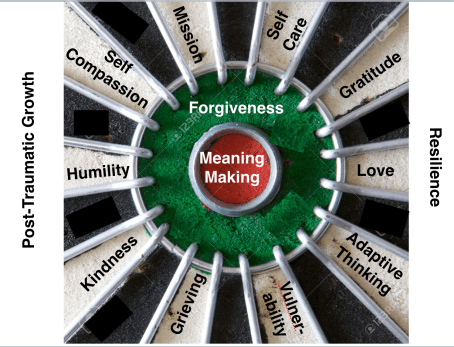
Screen Shot 2017-08-12 at 11.39.02 AMThis is the third post in a series on grieving. The first regards grieving in the first year or two. The second regards how to help a child to grieve. In this post I’ll review factors that promote post-traumatic growth (PTG) after a severe loss.

PTG is the process of experiencing growth because of the pain you have experienced. As one poet it, pain is a dragon guarding treasure. To get to the treasure, the dragon must have it’s way and the clawing can be terrible, sometimes even breaking a person. But, at some point, if you have gotten to the other side, the treasure is always present. And, while the pain often stops, or is at least is significantly reduced, the treasure keeps on gifting.

To check the truthfulness of this assertion, survey your life for the most painful events that are now behind you. Are there any ways you are better now because of that suffering? Or, look at PTG from another angle. Consider the best things in your life. Could any of them have existed were it not for suffering, either on your part or on the part of someone close to you?

The PTG concept does not suggest that the treasure is worth the loss, nor does itScreen Shot 2017-08-12 at 11.36.57 AM suggest that the circumstances of the loss had inherent meaning. While one or both of those things can be true, they are often not. So, the first thing to wonder, after your grief has subsided enough, is, what treasure has this (often terrible) loss made available to you?

I previously outlined 13 tips for promoting adaptive grieving. Building upon those, here are six strategies for promoting PTG:

1. Develop a daily gratitude practice. If you enter the word “gratitude” in the search bar above you will find several offerings on this topic.

2. Practice random acts of kindness. This can be applied to both family members and to strangers. Again, use the search bar above to find related blog posts.

3. Practice self-compassion as much as you can. I will be writing on this topic in the future, but for now can refer you to this website for a plethora of information on self-compassion: http://self-compassion.org. Note that you can find a questionnaire on this site for understanding where you stand on the self-compassion dimension.

Screen Shot 2017-08-12 at 11.44.59 AM4. Practice forgiveness. This is the hardest thing for many of us to do, and our culture often misunderstands the nature of it (e.g., forgiveness is not allowing ongoing damage, it does not require the other person to express remorse, it does not involve minimizing, or require forgetting, the assualt). Click here for a post I devoted to this topic.

5. Develop and live effective missions. Developing effective vocational and personal mission statements goes a long way to producing a more meaningful and satisfying life. I provide a introductory structure for getting there in this post.

6. Pursue the truth. This regards your thinking (e.g., depression always involves believing things that are not true). This regards how you view others (e.g., a harsh judgment always reflects a lack of information or a distortion of the truth). It involves everything. Yes, the truth can be challenging in the short run–I believe it is Gloria Steinem who noted, “the truth will set you free but first it will piss you off.” But, the pursuit of it is a guiding principle of high road living. By the way, it’s remarkable how often pursuing a path of loving kindness overlaps with this goal.Screen Shot 2017-08-12 at 11.47.13 AM
This is complicated stuff. So, if you’d like to find an ally for figuring it all out, and applying it to your life, consider meeting with a skillful mental health professional. For a referral, click here.



Helping Your Child Grieve a Loss

shutterstock_301610618No engaged parent is happier than her least happy child. It is very difficult for any of us to see our children in pain. However, grieving is adaptive suffering and knowing how to help our children through it, instead of suppressing it, is an important parenting skill. I will split my tips on this topic up into two sections: when you are not affected directly by the loss and when you are.

When it is not your loss also

Your teen might have been dumped by a crush. Or, your daughter may have failed to make the travel soccer team. Or, perhaps your child’s only and best friend moved away. There are many kinds of loss. Here are 10 suggestions for helping:

• Validate your child’s pain. It makes sense to hurt over a loss. Allow your child to express those thoughts and feelings without offering immediate reassurances. This is gruelingly difficult to do. However, many of us benefit by having company when in pain. Moreover, premature reassurances came come across as “please stop feeling badly now.” Later the odds are high that your child will appreciate your empathic companionship.

• Ask your child how she’s doing but don’t insist on a conversation. Part of grieving is choosing when to not think or talk about the loss.

• Ask other family members to reach out to your child, shutterstock_63342151checking in on a semi-regular basis; it isn’t sufficient to say to a child, “let me know if I can help.” Again, though, the emphasis should be that it is your child’s choice whether to talk or not when the other person reaches out.

• Encourage your child to memorialize the loss. There are so many ways to do this. Writing a letter–whether it is sent or not–drawing, creating poetry and creating art projects are all ways this can be done. Again, though, don’t insist.

• Try to avoid supporting numbing behaviors such increasing a diet of processed carbohydrates or oversleeping. That said, indulges here-and-there are usually harmless.

• Try to encourage regular fun activities that are (a) novel (b) social and (c) involve physical activity. This trifecta maximizes the release of mood lifting brain chemicals. Once a week or so is fine.

• If you share a spirituality with your child, suggest using it to process the grief. Praying together, going to services and sharing readings that are targeted for your child’s age can all be helpful.

• Try to keep as many of your rituals in place as possible. Rituals are islands of stability within the torrential currents of stress that our culture presents.

shutterstock_385425094• Make sure to spend one hour a week doing special time. You can get a summary of how to do special time by clicking here. To get the full description, read the first chapter of my parenting book. Remember that special time is not the same thing as quality time.

• If your child becomes unable to accomplish his major developmental tasks (e.g., academics, socializing), arrange for him to be evaluated by a child psychologist who is experienced in providing cognitive-behavioral therapy for youth. I would insist on an initial evaluation and not require your child to agree that it is a good idea.

When you share the loss with your child

• As difficult as it can be to help your child grieve, the situation is significantly more complicated when you are suffering from the same loss. Here’s the most important point: your healthy grieving should be a top priority. As an illustration, and quoting researchers Werner-Lin and Biank: “A child’s adjustment to the death of a parent is greatly influenced by the surviving parent’s ability to attend to his or her own grief-related needs.” For this reason, please see this blog post on tips for promoting your effective grieving.

Here are half a dozen tips for your shared grieving experience with your child:

• Let your child know that you are hurting too. The older your child, and the healthier she is from a psychological perspective, the more open you might choose to be about your pain. This can be especially challenging for men. When it comes to vulnerability, the research indicates that we men are often asked to be vulnerable, but when we are we can be less liked and even punished, sort of what women go through with being assertive (please see the body of work by Brene Brown to learn more about this).

• You might schedule times in advance to do some shared grieving.

• Memorializing projects can have more meaning if they are shared and displayed.

• Try not to be too upset with either of you for the vulnerabilities that result secondary to forgiveness as keyyour grieving. You may go through a period when you are grouchy or unmotivated or dour. Likewise, your child may go through a period when he is defiant or sullen or rejecting of your affection. These are often transient reactions; part of what helps them to not take root is to not overreacting to them.

• Seek parenting allies if you need a break. It can be hard for those of us who are proud or independent minded to reach out for help with parenting. But, ask yourself: how would you want a friend or loved one to think about the possibility of asking you for support if your roles were reversed?

• My final suggestion–that those of you who read this blog can see coming a mile away– is to seek out the services of a good family therapist if you are both suffering to the point that you can’t meet important goals in life. For referral ideas click here.

A Baker’s Dozen When Grief is New

headache backgroundThough they can inspire similar feelings, depression and grief are different. Grief is healthy while depression is not. Grief involves coming to terms with a loss. Depression involves needless suffering secondary to believing painful things that are not true (you can find several articles I’ve written regarding depression using the search bar above). The more important the loss the more intense the grieving. Healthy grieving is regularly remembering and feeling the loss of the person, across a wide array of memories and experiences, while simultaneously (1) memorializing the person, (2) maintaining effective engagement in life (including self-care) and (3) avoiding unhealthy. self-numbing behaviors. How long it takes to get to the other side of grief varies wildly from person-to-person. But, a general guideline is that it can take one year for the worst of it to be done and two years until it seems like life is mostly okay again. Here are 13 tips for those who are within the first two years of grieving:

  1. Find ways to memorialize the person who died. This can be extravagant (e.g., starting a foundation, creating a golf tournament) but certainly need not be. Indeed, sometimes people have made their grieving harder by taking on too much labor too soon after the loss. So, creating photo collages, works of art, videos and so forth can be helpful to memorialize the person.
  2. Don’t resist. When it comes to grieving suffering = pain x resistance. Allow the grief to come if you don’t have something you must do (e.g., go to work, attend a child’s recital). This feels counter-intuitive as we fight depression when it comes, as we should. But, grief is not depression. Each tear drop brings you that little bit closer to getting to the other side.
  3. If you have a hectic life, schedule time to grieve. When the time rolls around, bring upset man, black backgroundout mementos of your lost love and let the waves come.

  4. Try hard to get eight hours of sleep a night. If you can’t, consider tip #13. Everyone has sleepless nights but try to trend towards the eight. A rested body can grieve more effectively. (See this blog entry for some other tips regarding insomnia that might be easily adapted for your situation.)
  5. Limit numbing. Try to maintain a healthy diet and keep substance use to a minimum. Comfort foods should really be called numbing foods, and a numb person is not a grieving person. Again, we’re talking about trends. Everyone numbs some of the time.
  6. Be active. Try to get daily doses of physical activity. Sleep, diet and physical activity are the legs of the tripod upon which effective grieving is built.
  7. Be kind. While it’s helpful to be kind to others (of course), this tip is primarily referring to yourself. For example, don’t allow yourself to beat yourself up for mistakes, including–and couple, happymaybe even especially–ones that may be haunting you regarding the person you lost.
  8. Lean into spirituality. If you are a spiritual person, tap into your Higher Power daily. People do this in different ways: praying, reading, writing, meditating, going to services, talking with a spiritual director and talking with friends can all be helpful.
  9. Set boundaries. Set these up with people in your life. For example, you may need to tell co-workers that you prefer to be the one to bring up the topic of your loss. Having someone else bring it up, when you are trying to do something else, could be counterproductive.
  10. If others are experiencing the same loss, open up to each other about your shared experience on a regular basis. However, if either one of you doesn’t want to talk about your loss in a particular moment, it’s important to respect that also.
  11. Stay engaged. Try to socialize and have fun regularly. You may not feel like doing this much of the time. And, certainly give yourself permission to curl up into a ball with a blanket some nights. But, as a trend, try to do fun things with others on some regular basis.
  12. Tap your wisdom. New problems will surface during this difficult time as that’s the nature of life. Each of us have deep wells of wisdom within that we can tap in these moments. For example, ask yourself how you would decide about a problem you are facing if you were living the last week of your life. Or, if you have a child, ask yourself what you would counsel your child to do in the same situation 20 years from now. Another very helpful technique is problem solving, which I describe here.
  13. Consider CBT. We all battle with internal enemies. Sometimes we use friends, or therapy etchingself-help books or mentors or prayer or other personal assets to help us with these battles. At other times, meeting with a therapist to do an evidence-based and skill building therapy can be extremely help. Cognitive-behavioral therapy is often the treatment of choice for dealing with grief related challenges. (If you enter “cognitive behavioral therapy” in the search bar above you’ll find a few articles I’ve written describing this treatment approach).

In subsequent blog entries I’ll write some tips for helping a child to grieve, suggestions for those whose grieving is further along, as well as a few other grief related topics.


Making the Most out of New Years Resolutions

excited man pointing, long hair, tieMany of us will soon make New Year’s Resolutions. This entry is designed to increase your odds of success. I’ll review four planning steps and ten strategies for promoting effective outcomes.

The first step in the planning phase is to visualize what you like about yourself. I’m skeptical that your self-improvement project can survive and thrive if you do not know and enjoy your strengths, not only at the start, but consistently throughout. I like a prayer that British psychologist Robert Holden recommends in one of his books: “Oh God, help me to believe the truth about myself, no matter how beautiful it is.  Amen.”

The second step is to picture yourself as the most fulfilled version of you. What is different about that person? What changes, that are under your control today, would help to get you there? (If any of us drove a car as reliable as willpower, we’d soon scrap it. Yet, many of us continue to rely upon will power as if it could be consistently counted upon.)

Third, list the obstacles you’ll experience in taking this voyage. This is a step worthy of your most honest and thorough consideration (many of these obstacles are authored by the person in the mirror).

challengeFourth, what steps can you take to reduce the obstacles and lessen your reliance on will power?

A problem that many of us run into is called “present bias.” The person who we are when we make a resolution–present me–is steely eyed and filled with gritty resolve. However, present me may also be inclined to be harsh (“okay, you really need to stop being so weak!”), excessively ambitious (“I’m going to never yell again!”) or inclined to invest in ways that aren’t always helpful (e.g., purchasing expensive equipment the like of which has never been used before). The problem is that present me is not the same person who will be doing the heavy lifting; that person is future me. If present me doesn’t adequately understand future me’s strengths and vulnerabilities, then present me is destined for disappointment.

Each of us are like snowflakes, completely unique. Thus, a strategy that helps another person make substantive changes could be a horrible idea for you. Use your world’s leading expert knowledge of yourself to develop a plan that is supportive of future you. Use her strengths. Establish support for his vulnerabilities. Some of the following ten tips may help:

1. Set daily goals. Avoid goals like “I’m going to lose 30 pounds.” Instead, try “today I’m going to eat a balanced diet and get 45 minutes of physical activity.” (Goals like this are very nice if you mess up as tomorrow is a new day!)

2. Keep a daily log of those behaviors that are most important to your goal(s). persistenceMany self-destructive behaviors occur when we disassociate from ourselves (i.e., only partially notice what we’re doing). Writing stuff down combats disassociation and increases the odds that you will remain self-aware and in the moment.

3. Join with others. Two things characterize those who are successful in setting aside entrenched and self-limiting patterns: they work on themselves and they surround themselves with people who are striving towards the same goal(s). Relying on others could involve partnering with friends, starting counseling, or attending support group meetings. (To find a therapist near you click here.)

3a. Ask your partners for help. Many people are willing to help your future self reach your present self’s goals. All you need do is share your vulnerabilities and ask for ideas and/or assistance. For example, I know one pair of friends who committed to playing a rotating aerobic game before work each day (e.g., basketball, racquetball, etc.). They rotated the role of cheerleader for those days when one or both of them was tempted to cancel.

ideas4. Establish rewards for yourself. For instance, so many days of doing as you vow earns you a treat. Also, give yourself hefty mental pats on the back for success along the way.

5. Take lapses as opportunities to learn more about your vulnerabilities and how present you can do a better job of supporting future you. Avoid being cruel and harsh with yourself as this risks putting your goals further out of reach (i.e., don’t tolerate bullying!). I’ll sometimes ask clients, who are parents, to react to themselves as they would react to their child if their child showed a similar lapse (sometimes this involves projecting forward in time and imagining their child at their age, having fallen prey to the same vulnerability).

6. Use music if that motivates you.

7. Focus your mind on the positive behaviors you want to do rather than the negative behaviors you want to avoid. It’s better to focus on what healthy breakfast you want to eat rather than trying to use white-knuckle willpower to resist the unhealthy version. A great book I recently discovered that does this well is The Happiness Diet, by Graham and Ramsey

8. Have present you write encouraging and positive messages for future you that you put in your electronic calendar.

9. Make a plan to remove as much temptation as possible from the eye line of spiritual manfuture you (remember: will power is unreliable).

10. If you are a spiritual person, lean on that part of your life as much as you can.

Good luck! And, remember, high road life is less about outcomes and more about being in the right fights 😉

Preventing and Responding to Anxiety

anxious childResearch indicates that kids are sometimes born with a temperament that predisposes them to develop an anxiety disorder. This temperament, called “behavioral inhibition,” can be identified in toddlers. Such toddlers tend to have nervous responses to novelty or unexpected changes; they also tend to be more clingy and fussy than their peers when faced with separation from a primary caregiver. Toddlers with this temperament are then at higher risk for developing an anxiety disorder. What follows are six tips for trying to help such a child to not develop an anxiety disorder.

1. Avoid avoidance. This is one of the most important guidelines. This means not avoiding those developmentally appropriate situations that make your child feel nervous. When our kids hurt we parents hurt worse. So, it’s a natural reaction to just let our child avoid any developmentally appropriate situations that make her feel nervous (e.g., being left with a babysitter, getting on a school bus, joining a rec soccer team). Avoiding such situations reinforces the notion that they are dangerous and also tends to promote them becoming even more threatening over time. Moreover, this sort of a coping strategy tends to spread: your child may end up wanting to use it for more and more situations. Barring other complicating factors (e.g., the presence of Post Traumatic Stress Disorder), avoiding avoidance usually comes with initial distress but is followed by calm and a sense of accomplishment. (“Eventual” often ends up being just a few minutes.)

2. Promote your child’s comfort as you avoid avoidance. This can be coaching soccerdone in any number of ways. One of my favorites is to gradually expose your child to aspects of the feared situation in doses before the due date. For example, you might play soccer with him on the field where the first practice will be held or arrange for her to sit on the empty school bus before the first day of school. You would usually stay within these situations until your child seems calm, using some of the other tips in this article. This can also be done in smaller chunks prior to the due date.

3. Teach belly breathing and pasta muscles. Have your child pretend that his lungs are in his lower belly, instead of his chest cavity, while breathing deeply but comfortably, both in and out. Relatedly, ask your child to make her muscles as soft as a piece of cooked pasta. Click here for a free 15-minute audio training module I created that can promote this sort of muscle memory. These behaviors short-circuit the fight-flight response, which is the brain system that becomes activated whenever someone feels anxious. (When in the anxious situation your child should not tense then relax his muscles, as is done in the training module. That is only done for practice. When in the anxiety provoking situation, only relaxation and belly breathing should be used.)

tape over mouth4. Avoid reassurances, especially those that are excessive. Few things will trigger your child’s anxiety more quickly than your reassurance that a safe situation is safe, especially when those reassurances that are issued with emotion or conviction. I tell the parents in my practice, “imagine I told you not to worry about the ceiling over us collapsing on top of our heads. You’d probably instantly start wondering what sort of a dangerous situation you might be in.” Kids often hear many parental reassurances as, “time to start freaking out!” Moreover, when you are separating from your kid (e.g., leaving the practice, leaving the school), leave as quickly as you can. Your presence, and especially if you are issuing reassurances, will often tend to promote the very anxiety you’re trying to mitigate.

5. Get control over your own anxiety if that’s a problem. This temperamental vulnerability, by definition, usually runs in families. If anxiety is interfering with the quality of your life, you would do your kid an awesome solid by seeking out cognitive behavioral therapy for yourself.

6. Get help if these efforts don’t work! Anxiety disorders in anyone, including kids, is usually very treatable and in a short period of time. The aforementioned cognitive-behavioral therapy can be delivered to kids and teens and has a ton of research supporting its efficacy. For a referral, click here.


Promoting Teen Friendships

2 happy teens, african-americanAs we start a new year, my attention is drawn to The New Yorker article by Maria Konnikova titled, “The Six Most Interesting Psychology Papers of 2015.” I’d like to blog on one of these six articles, from the British Journal of Psychology, titled “Best Friends and Better Coping: Facilitating Psychological Resilience Through Boys’ and Girls’ Closest Friendships.”

In this study the participants were 409 “socio-economically vulnerable” British adolescents. The researchers found that having a close friend served an important resilience-promoting function. They concluded: “Findings revealed a significant positive association between perceived friendship quality and resilience…We suggest that individual close friendships are an important potential protective mechanism accessible to most adolescents.”

This is not a surprising result for those who are familiar with the resilience literature (e.g., social competence is a well established protective factor). Here are a few tips parents can use to promote friendships among their teens:

  • Create a space in your home that is teen friendly. Key ingredients aretwo women fun things to do in a space that feels separate from parents and siblings.
  • Encourage and support extra-curricular involvements that tap into your teen’s strengths. This can be a wonderful way to develop and support friendships.
  • In instances when your teen may be struggling with peers, partner with teachers in identifying potential friend-candidates to invite over.
  • Also if your teen is struggling, see if there are any groups being organized by school counselors that your teen might be eligible to join (e.g., social skills training, divorce coping, grief); these groups can be useful for forming bonds.
  • Whenever practical and consistent with your morals, support your teen’s efforts to acquire conforming clothes, music and so forth. These are common methodologies teen use to try to feel comfortable around, and to fit in with, peers.
  • Whenever practical and consistent with your morals, allow your teen to have access to pro-social networking sites and technology (e.g., texting). Not having access to such can serve to isolate a teen.
  • happy latino coupleGiven how critically important this domain is, please consider obtaining an evaluation from a good child mental health professional if your teen is struggling with peer relationships. For a referral click here.

This complex topic goes hand-in-hand with another complex topic: parental monitoring. Please use the search bar above, or my parenting book, to find content along those lines.


Parenting a Depressed Teen During the Holidays

depressedThe holiday season can be harder than other times of the year for people who are depressed. When someone is struggling with depression he feels estranged from himself and the world. Then, when that world temporarily gets even more unlike him (i.e., emphasizing cheer), his sense of estrangement can worsen. For this and other reasons, parenting a teen who is depressed during the holiday season can especially challenging.

Before I offer some tips, let me offer a very important proviso. Imagine you had a kid with significant dental pain and you wondered, “what meals should I prepare that best accommodate her condition?” That seems like a useful question, but only if your daughter is receiving, or is about to receive, professional dental care. Without the dental care, cooking interventions would probably be like re-arranging deck chairs on the Titanic. It is the same thing with depression in a teenager. The tips below are best considered and rendered within a context of a kid already getting good mental health care (e.g., an evidence based talking therapy such as cognitive-behavioral therapy or interpersonal therapy).

That said, here are seven tips to consider:

• Collaborate with your teen, and ideally your teen’s treatment provider, regarding a holiday plan (e.g., which activities to do and which to set aside). Your teen’s depression would have him bail out on most, if not all, activities and that is usually a mistake. Likewise, you may be tempted to insist on 100% participation, and that can be a mistake as well. A skilled therapist’s expert assistance can increase the odds that you’ll find the adaptive middle ground.

• Do what you do for your teen without the expectation that such will cheer her african woman's half faceup. We parent-lunatics hurt when our kid hurts, and often worse. So, it’s very natural to try to cheer up a depressed teen. However, if the primary intention is to bring about a better mood it’s easy to become frustrated and worsen the stress on our teen. Better to make the effort without the expectation of an outcome.

• Accept your teen’s moods as they come. These moods can be like the weather. Sure, you’ve laid out a nice picnic and here comes a rainstorm, and that stinks. You can rage at the weather (and that can take many, many forms) or pitch a tent, realizing that the weather is outside your control, and enjoy what is possible to enjoy.

• Resist trying to reassure your teen out of a negative thought. While such encouragement can often help someone who is not depressed, to a depressed person reassurances can sound like, “you don’t have anything to feel sad about, so stop it,” which can then cause the depressed person to become even more adamant about his negative thinking. This is another instance where your teen’s therapist can be very helpful in coaching you how to respond (e.g., “I think that’s your depression convincing you of a painful lie. I believe the reality isn’t nearly as painful as your depression’s lie); the technique of thought testing can also be very helpful here (e.g., see my parenting book or search using that term above).

• Don’t allow extended family to hassle your teen regarding his depression. Loved ones can say some pretty hurtful things in their desire to be helpful. Your teen’s therapist can help you to figure out your methods for doing this in a way that respects your teen’s privacy and independence.

teen diinterested face• Regularly let your teen know, without overdoing it, that you love her, that she is not alone and you understand that it’s terrible to be feeling what she is feeling, especially during the holidays.

• If your teen is or could be suicidal, get him in front of an expert ASAP and don’t leave him alone until you do. Consider this to be a life-or-death emergency as you certainly don’t want your baby to be one of the two million U.S. teens who attempt suicide each year.

Geez. Tough stuff huh? But, hopefully there’s a helpful tip or two here for you. Regardless, I hope you and yours have a wonderful holiday season!


Is being spiritual healthy?

girl smelling a flowerIn last week blog’s entry I reviewed a recent study suggesting that religiosity and altruistic behavior are negatively associated in children. In that study, the findings were weak and there were important questions left unaddressed. In this week’s blog entry I would like to quote from two comprehensive reviews of the literature regarding associations with spirituality and religiosity that have appeared in two flagship journals: The American Psychologist and Pediatrics.

The review article in The American Psychologist, by researchers Peter Hill and Kenneth Pargament, can be found here. These are some key quotes:

“…religion and spirituality have been surprisingly robust variables in predicting health-related outcomes.” These include “…heart disease, cholesterol, hypertension, cancer, (and) mortality…”

“…even simplistic religion and spirituality measures…are glorioussignificant predictors of health outcome variables.”

Citing a meta-analytic review (i.e., a study of studies) of nearly 126,000 participants: “…people who scored higher on measures of religious involvement…had 29% higher odds of survival…than people lower in religious involvement.”

“…people who report a closer connection to God experience…less depression and higher self-esteem…less loneliness…greater relational maturity…and greater psychosocial competence…better self-rated health…and better psychological adjustment among people facing a variety of major life stressors, including transplant surgery…medical illness…and natural disasters…”

The review in Pediatrics by researchers Linda L. Barnes, Gregory A. Plotnikoff, Kenneth Fox, and Sara Pendleton can be found here. Here are some key quotes from that article:

diverse happy woman on floor2Regarding youth: “A number of studies suggest that spiritual/religious beliefs and practices may contribute to decreased stress and increased sense of well-being, decreased depressive symptoms, decreased substance abuse…improved recovery from myocardial infarction and enhanced immune system functioning.”

“Instances in which spirituality and coping may intersect for children include nighttime fear, psychiatric problems, suffering, hospitalization, disability, cancer and terminal illness.”

“Spirituality and religious involvement can also help children withstand the emotional assaults of sexual abuse, racism, cultural destruction, and the trauma generated by refugee experience and life in the disenfranchised urban neighborhoods.”

“Low religiosity also tends to be related to higher rates of smoking, drinking, drug use, and adolescent pregnancy.”

Other correlates or religiosity cited in the latter study included baby in shades, good for dev jeopardyless male aggressive sexual behavior, lower delinquency, higher life satisfaction, lower suicidality & increased academic & social competence.

Keep in mind that a correlation tells one nothing about cause and effect (e.g., click here for a demonstration of that truth). However, when study after study, across decades, finds similar positive associations, we can start drawing conclusions. What causes the positive associations is an open discussion (e.g, see Chapter Four of my parenting book), but we are on firm ground to assert that scientific findings indicate that engagement with a spirituality promotes resilience across the lifespan.


Religiousness and Altruism in Kids

microphoneLast week media outlets around the country reported on a study out of the University of Chicago on the relationship between religiosity and altruism in kids. The study can be found here. These are some of the headlines from last week: “Nonreligious children are more generous.” “Religion doesn’t make kids more generous or altruistic, study finds.” “Religion Makes Children More Selfish, Say Scientists.” How this research was portrayed constitutes a case example of what can go wrong when social science research is presented to the public.

The participants of this study were “…1,170 children aged between 5 and 12 years in six countries (Canada, China, Jordan, Turkey, USA, and South Africa).” The key determiner of altruism was how many stickers kids were willing to share with peers. Kids in the non-religious group were willing to share, on average, 4.1 stickers (out of 10) while kids in the Christian group were willing to share 3.3 stickers and kids in the Muslim group were willing to share 3.2 stickers. The researchers also determined that the correlation between the kids’ religiousity and altruism was -.173 (negative correlations mean that when one variable goes up, the other one goes down).

question mark over brainTo better understand the confusion in the reporting I need to explain the term “statistically significant.” Research is always done with samples that hopefully represent the population under study. So, let’s say I’m a researcher that believes that 10 year old boys who eat apples for a year will end up taller than 10 year old boys who eat onions for a year. I then put together a sample of 800 10 year-old boys, half of whom eat the apples and half of whom eat the onions for one year. A test for statistical significance tells me, at the end of my study, whether my sample of 10 year-old boys represents all ten year old boys (the population). Lets say at the end of the year my test of statistical significance says that my results are statistically significant. All that means is that my sample likely represents the entire population (the standard cutoff is 95% likely or higher). However, statistical significance tells me nothing about the meaningfulness of the difference. So, lets say in my study the boys who ate the apples were .84 inches taller than the boys who ate the onions. I can tell the media that there is a significant difference between my two groups, and that would be true. But the media, and the public equate “significant difference” with “meaningful difference” and that would be troubling, especially to onion farmers.

An example of a statistic that speaks to meaning is effect size; .20 is a small effect size, .50 is a moderate effect size and .80 is a large effect size. Moreover, to consider the meaningfulness of correlations, .10 is considered small, .30 moderate and .50 is large.

So, let’s return to the study in question. The effect size on the main analysis (which they didn’t report but which I calculated) is .348, closer to the small category than the moderate category (e.g., there was a .8 sticker difference between the non-religious kids and the Christian kids). Moreover, the negative correlation of -.173 correlation is small.

But, we need to return to my apple-onion study to consider another methodological issue. Researchers commonly collect data on other related variables that might moderate the results. Do the apples and onion diets have differing effects on boys who start out shorter than boys who start out taller? Do boys who are obese have a different outcome than those who are not? Are the results different for boys who exercise than those who don’t? Including measures like these helps researchers to further interpret the meaning and relevance of the results. In well-constructed studies such analyses are common.

In the study in question there were numerous potential moderators that were not investigated. These included the presence of mental health problems among the kids, the level of intelligence of the kids, and the number of siblings in each participant’s household, psychology disciplineto name a few. Moreover, a key potential moderator variable, socio-economic status, was assessed merely by determining the mother’s level of education. So, even though the results are statistically significant, the effect sizes are small and there are many unanswered questions regarding potential moderators of the findings.

Is this study interesting? Yes. Does it make a useful contribution to the literature? Yes. Does it suggest that parents should alter their religious practices based on its findings? Absolutely not. Moreover, there is a great deal of scientific evidence indicating that numerous physical and psychological advantages are associated with religiosity in children. In next week’s blog I will review some of that science.

Value of an Allowance

money held by handMany parents wonder about the value of giving their kid(s) an allowance. I’m in favor of allowances for these reasons:

Allowances…

…can be tied to weekly chores or homework performance, incentivizing otherwise resistant kids.

…cut down on the revolving (and seemingly near constant) requests for spending money. For elective purchases, kids can now learn to budget their own resources.

…open the door to teaching about money management. For instance, a percentage might be put aside for college, teens might open up a checking account and so forth.

…get kids thinking about the importance of giving to charity.

…sometimes actually lead kids to ask for other opportunities to earn money around the home.

Parents often ask me how much they should allow their child to earn. There isn’t really a guideline that I can say is more or less psychologically indicated. It really comes down to your standard of living and the values you wish to promote. That said, you could think of $1 per year your child has lived outside of the womb as a rough starting point; you can adjust up or down from there based on your standard of living and values.

Let me offer two caveats:

First, it’s important to not make a kid spend his or her allowance on necessities such as clothes and food. Providing necessities is our job. Of course, if your budget parameters call for your child to bag her lunch, but she prefers to purchase it at school with her allowance, that’s fine. Or, you have it in mind to purchase a durable sneaker but your kid wants the designer brand, that’s fine also.

Second, it’s important to not try to over control how your child spends his or her allowance. If the proposed expenditure isn’t inappropriate for him or her (e.g., a 10 year old wanmentorts to purchase a mature rated video game), or immediately harmful (e.g., yes, too much ice cream is harmful in the long run but a dosing of it isn’t immediately harmful once allergies are ruled out) it’s important to let your kid make his or her own decision, even if it drives you crazy. It’s hard to learn how to manage money, and how to make decisions, if mom or dad are always calling the shots.