Tag Teen

Top 10 Ways to Get Your Teenager to Clean His or Her Room

Tell him/her that doing so is the only way she/he can get you to not…

  1. send his cutest picture walking in a diaper to his friends’ cell phones.
  2. dance at the next dance she attends (model making a lasso over your head with one hand and smacking your backside with the other).
  3. hold his hand the next time you’re at the mall.
  4. share the name you had for him when he was a baby the next time you give his friends a ride.
  5. rap when her friends come over.
  6. ”accidently” text her boyfriend asking if she has completed her daily prayers yet.
  7. stand up at the next religious service your family attends, at an appropriate point, and ask if you could offer an example of your teen’s virtuous behavior so that other teens might benefit.
  8. keep clapping, after everyone else has stopped, at her next performance (sports, music, acting, etc.), shouting “woo-hoo! go girl go!”
  9. take out an add in the local paper with the caption “For (name of your teen)” with the words “Remember, mommy and daddy will always love you no matter what!”
  10. show up at her school wearing high water pants and green socks and
  • if you’re a mom: bright pink lipstick that you apply outside of your lip line.
  • if you’re a dad: moussed, spiked hair.

Of course, these are meant for the sake of humor only (well, mostly 😉 ). But, if you really are struggling with your teen’s behavior, perhaps a child therapist could help. One place where you might find a local referral is here.

10 Strategies If Your Child is Addicted to World of Warcraft (WOW)

According to the 2010 Guinness Book of Records, World of Warcraft (WOW) is the number one “massively multiplayer online role-playing game” or MMORPG, with over 10 million subscribers world-wide. WOW is a fun open-ended online game that can, for some kids, become an unhealthy obsession.  If you’ve determined that your child is overly engaged in WOW, consider these ways of responding:

  1. Try to understand what human need is being met for your child by taking part in WOW. Is it to be liked? Is it to lead? Is it to be competent? An effective understanding of the reasonable goal(s) your child is trying to reach through WOW can give you insights into what is being frustrated in his or her real world.
  2. Try to partner with your child in expanding upon the success she or he is having in the real world. This may be socially, academically, extracurricularly or within your home.
  3. If your child has not identified areas of top strengths, use tools like the VIA Signature Strengths Survey or StrengthsExplorer to generate theories about what  he or she might be very good at.
  4. If he or she has not done well with popular activities (e.g., sports offered at school, the most readily available clubs, etc.), try activities off the beaten path, using your child’s interests or insights from the previous recommendation to guide you.
  5. Look for partners in generating plans for increasing your child’s success in life. This might include teachers (most of whom are most willing to help), coaches, family, parents of your child’s friends, etc.
  6. Try to limit your child’s sedentary electronic pleasures to two hours a day. This is the sound counsel of more than one authoritative body (e.g., the American Academy of Pediatrics). If your child is doing more than this he or she may be missing out on other important developmental tasks (e.g., getting enough physical activity, advancing in reading skills, etc.)
  7. Explain to your child why you are putting any limits in place. This is done not to solicit approval (e.g., “thank you mother for being so wise and self-less in the administration of your parenting mission”), but to be respectful and loving. Of course, this will not typically mitigate passionate objections to the court from your child.
  8. Put appropriate electronic controls in place. Blizzard (the company behind WOW), has parent controls available within the game. Please click here to get started. There are also a variety of controls available either within many computers and televisions, just call the relevant technical support person. Finally, there are companies that sell products that make it easier for you to put controls into place (e.g., www.familysafemedia.com).
  9. Try to make sure that you are your child have at least one hour a week together where all you do is pay attention to your child and value either what your child is doing and/or saying. Called “special time” this involves  a more intense dosing of attention than  “quality time” (i.e., something else typically captures a parent’s attention  during quality time, such as shopping, fishing, etc.).
  10. There is an army of lean-mean-healing machines available and willing to help you in your efforts to help your child. If you find that this is complex or difficult for you to resolve on your own or that your child is having a toxic reaction to your efforts to establish loving controls, consider taking the step of identifying a child therapist to help. One place to get local referrals is here.

Research suggests that effective parental monitoring is one of the most powerful ways to promote resilience, happiness and wellness in your child. Hence, your well designed  efforts along these lines are usually well worth it!

Conversation Starters for You and Your Teenager

Getting a conversation going with a teen can feel like trying to move a building with a crowbar. If you’re having a hard time engaging your teen in conversation, some of what follows may help.

Begin by committing to one hour a week of a unique type of conversation (i.e., one 60-minute period, three 20-minute periods, etc.). In this conversation all you would do is pay attention and express positive thoughts and feelings, including empathy. Try to avoid teaching, correcting, moralizing, etc., during this hour. (Think of this as good practice for when you’re an in-law.) You can sit on your teen’s bed at night, get to a movie before the commercials, use car trips, etc. You could print out the following list and ask your teen to pick some to react to.

Answer both the question, and “how come” you gave that answer:

• The best thing that happened to me so far this year is…

• The worst thing that happened to me so far this year is…

• The thing I like to do the most is…

• The thing I like to do the least is…

• The best thing about you as a father/son/mother/daughter is…

• In 10 years I hope…

• If I had three wishes I’d wish for (avoid wishing for more wishes or cash and it has to be about your own life so “world peace” won’t work)…

• One of my favorite movies of all time is…

• My favorite recording artist is…

• If I could have any job in the world it would be…

• My favorite word is…

• My least favorite word is…

• My favorite TV show is…

• The thing I like best about our family is…

• It would please me if you were interested in…

• The three people who have most influenced my values and thinking are…

• A one-month all expense paid trip I’d like to take anywhere in the world is..

• Three people from history I’d most like to have as guests in our home are…

• An important change I want to see in myself is…

• If I could have any superpower it would be…

• My favorite video game is…

• I think the key to happiness is…

• When I’m on my death bed I hope I can look back and…

• My favorite thing about us as a family is…

• My favorite internet site is…

• Our families top opportunity for growth is…

Three closing thoughts: first, even your teen’s dialogue may seem simplistic (i.e., you want to discuss all the colors of the rainbow but she all she can do is black ‘n white), the value of the exercise is still there as long as you’re attending and valuing. Second, consistent application of this exercise can yield tremendous benefits not only for your relationship with your teen, but also for your teen’s wellness.  Finally, if you find that you cannot reach your teen perhaps your local friendly mental health professional can help. One place to locate someone is http://locator.apa.org/.

Good luck!

We Parents are Lunatics

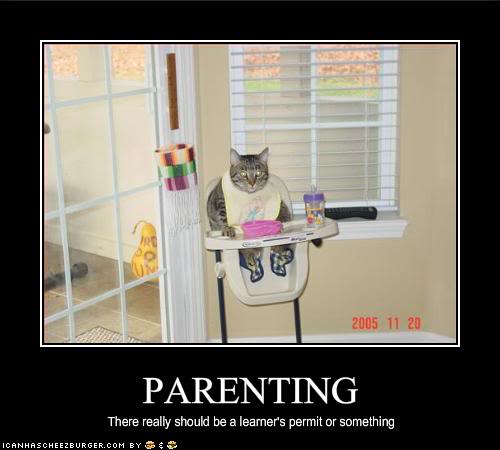
I was working clinically for 10 years with kids and their parents before I had my first child. (I now have 3.0 of them!) It would seem to me that the parents I was working with would become temporarily insane some of the time. We seemed to have a good relationship, and they seemed to value the service I was offering, and yet they would sometimes become so easily offended or hurt. THEN, I had my first child and I understood within a day what was going on. We parents love our kids so much that it can overwhelm us. In other words, our great love intermittently makes us parent-lunatics.

Before having my first child, Morgan, it would seem to me that the loving relationships I had in my life were like soothing waves that I could float in or swim with as I chose. However, this love was like a powerful wave that knocked me knees over elbows and took me where it would. I remember thinking, just after Morgan was born, that the love hurt and made it difficult to breathe. I also remember, in my efforts to be a good father, how crazy I acted (e.g., insisting on not being parted from Morgan so that the nurse could care for her, that we use a wipe warmer, etc.). And, if ever I forget about my own capacity for lunacy, I have only to monitor myself for a week or so. 😉

My primary goal in this blog, my co-parent-lunatic, is to support your mission to promote happiness and wellness in you, your child and family. But, in doing so I promise to remember my own lunacy when offering resources and making suggestions. But, this is not my only central promise. In the ensuing days I will review a few other ones as well.