This week’s entry is a guest blog located on Dr. Lamar Freed’s website. Click here to go there.
Promoting Resilience in Kids

This week’s entry is a guest blog located on Dr. Lamar Freed’s website. Click here to go there.
 Research suggests that attitudes about sleeping in the parental bed, or co-sleeping, vary across cultures. If a given culture finds this to be acceptable, and the family enjoys it, then there doesn’t seem to be any problems affiliated with it. So, this blog entry is not for those situations. This entry regards situations in which a kid expresses distress at sleeping in his or her own room, the most common cause of which is anxiety.
Tip #1: Consider whether you or your family’s dynamic is facilitating your child’s distress. Sometimes it is a parent who feels anxious about a kid sleeping in his or her own room (e.g., “what if a burglar breaks in and I’m not there to help?!”). Or, it may be that the kid sleeping in the bed averts dealing with a problem in the primary adult relationship (e.g., one parent wants to avoid conflict over sex). Dealing effectively with such underlying issues sometimes can make the surface problem go away on its own.
Tip #2: Avoid avoidance. This is good counsel across all domains of a kid’s life. Anxiety is fed when a kid avoids developmentally appropriate and safe situations because of fear.
Tip #3: Approach the situation with a calm, kind and firm manner. In regards to we parent-lunatics: when our kid hurts we hurt worse. Because of how our kid’s distress makes us feel, we sometimes react without considering whether the distress is good for our kid to experience (e.g., we remove the distress, we get agitated at our kid, we cave in).
Tip #4: Avoid excessive reassurance. A reassurance indicates that there is  something potentially dangerous at hand. When explaining this principal to parents I’ll say “imagine I told you not to worry about the roof of this office collapsing on us. Can you sense the discomfort you’d start to feel about the security of the roof?”
Tip #5: Figure out the pacing of the “exposure.” Exposure means allowing (or sometimes forcing) a child to face a developmentally appropriate and safe situation that distresses him or her. If the amount of distress is manageable, the strategy may simply be to insist that he or she sleep in his or her own bed. If the amount of distress is more severe, you can introduce a schedule (e.g., at first you sleeps in your child’s room for a week or so, then you transition to sleeping there only until your child falls asleep, then only for a few minutes as your child settles in and then not at all).
 Tip #6: Consider reasonable steps for promoting your child’s comfort. You might decorate the room in a motif pleasing to your child, allow him or her to sleep in special pajamas, leave on a night light, leave your child’s bedroom door open or allow him or her to fall asleep to music or an audio recording of a familiar story. (You don’t story to be so novel and interesting so as to keep your child up. You also want to be sure to turn it off after your child falls asleep as the quality of his or her sleep will not be as good if it remains on. The same goes for music.)
Tip #7: Many kids don’t need this, but you could always set up a reward program. For milder instances this could be as simple as putting stars on a calendar and offering a treat when 7-10 stars are earned (e.g., having a sleep over, purchasing a desired video game). For more entrenched and difficult situations you can set up a daily reward (e.g., TV is earned the next day by having gone to bed properly the night before) as well as a bonus (e.g., a trip to a local water park is earned after 14 nights of sleeping in the bed). (If you set up a program where X number of days earns a reward, it typically would not be required that the days be consecutive.)
Tip #8: If the above self-help interventions do not work, seriously consider consulting with a child psychologist. There may be other complexities at play or your child may need treatment for an anxiety disorder (most of the time anxiety disorders can be treated efficiently and effectively through cognitive-behavioral therapy). To find a provider near you, click here. Below are some related blog posts that you might also find to be of interest and don’t forget to follow me at my Twitter feed: @HelpingParents):
My Child Gets Afraid A Lot. What Can I Do?
Mom Arrested For Giving Her Daughter Xanax: CBT Can Help to Avoid Such Sad Stories.
Signs That a Kid Needs Mental Health Services
 What follows I find, in my professional and personal dealings, to be the most common mistakes we parents make. At the end of each of them I’ve listed the chapter in my parent book Working Parents, Thriving Families: 10 Strategies That Make a Difference (WPTF) that offers an expanded discussion and specific strategies for dealing with each problem as well links to related blog posts.
#1: Imagining that there will be more time for the family next week.
One of the most important exercises I ask parents to do in my practice is “special time.” This activity, which is different from quality time, takes one hour a week. So, so many parents believe that it will be easy to “make” this time (there is no “finding” the time, only making it) each week only to learn that it is extremely difficult to do so consistently, an insight that is instructive.
When parents describe a week when they did not complete special time they stress how unusually busy it was. While there certainly can be exceptionally busy weeks, most of the time the only thing that rotates is what is causing the extreme busyness, not the extreme busyness itself.
See Chapter One, Complete One Hour of Special Time Each Week With Your Child in WPTF for more.
Related blog posts:
• Conversation Starters for You and Your Teenager
#2: Parenting from a cross.
The research makes it clear that our collective parental self-care is often quite poor and that this causes significant stress on not only on us, but also on our partners and our kids. My experience is that the number one reason we good parents fall into this trap is because we are consumed by work and family duties. An image comes to mind: the oxygen masks having dropped in an emergency situation on an airplane and a woozy parent, who is not wearing an oxygen mask, is consumed by securing a child’s mask
See Chapter Seven, Take Care of Yourself and Your Relationship With Your Significant Other, in WPTF for more.
Related blog posts:
• Six Tips for When You Lose It With Your Kid
• 51 Truths (As I See Things Anyway)
• Effective Romance Helps Effective Parenting
• Lions and Tigers and Vows, Oh My! 10 Tips for Taking Your New Year’s Resolutions from Oz to Kansas
#3: Praising poor performance.
The pervasiveness of this leaves me feeling confident that you could go to any  youth baseball game in your community this weekend and likely hear examples of parents praising their kids for striking out, or making errors or for other kinds of poor performance. We know that facilitating our kids’ self-esteem is important. But our compressed and crazy-busy lifestyles sometimes cause us to use techniques that are either not helpful or that facilitate negative outcomes (e.g., self-entitlement).
See Chapter Two, Discover, Promote and Celebrate Your Child’s Competenites, in WPTF for more.
Related blog post:
• Five Questions for Effectively Parenting Kids in Sports
#4: Trying to undo a kid’s pain.
One of my favorite quotes is by Kahlil Gibran in his great, little book The Prophet: “Your pain is the breaking of the shell that encloses your understanding.” We good parents hurt worse when our kids hurt. So, we try to take it all away; if we are successful we limit our kids’ wisdom.
See Chapter Six, Promote Health Decision Making, Independence and Adaptive Thinking, in WPTF for more.
Related blog post:
• Failure: An Important Part of Psychologically Healthy Childhood.
#5: Missing the middle ground on discipline.
 It’s amazing how often the word “discipline” is equated with butt kicking. Actually, the root of the word is “to teach.” I would argue that the top outcome effective discipline promotes is our child’s capacity to do things well when he or she doesn’t feel like it. This is the psychological muscle group that best predicts success in our culture.
It is easy to wrap ineffective discipline strategies in truisms. The parent who is soul weary and disengages from discipline might say “you can’t make all their decisions for them. Kids have got to learn to make their own mistakes and to figure things out for themselves!” Likewise the harsh and unyielding parent (it takes less time to parent in this way than to discipline effectively), might say “kids have to learn respect and to do as they are told!”
To discipline well is one of the most challenging and time consuming aspects of effective parenting. As we are so, so tired and so, so overextended, it’s easy to miss the boat.
See Chapter Five, Practice Sound Discipline, in WPTF for more.
Related blog posts:
• Six Reasons to Avoid Spanking
• Seven Tips for When Your Child Refuses to do a Chore.
• Top 11 Tips for Parenting Teens
#6: Enabling sleep deprivation.
There is an epidemic of sleep deprivation among our youth. The more researchers examine the consequences of this, the more we learn how impairing a lack of sleep can be across all the major domains of a child’s or teen’s life. Again, it is much, much easier to let this go than it is to ensure that our kids get enough sleep.
See Chapter Eight, Emphasize a Healthy Lifestyle, in WPTF for more.
Related blog posts:
• Is Your Kid Getting Enough Sleep?
• A Chronic Health Problems in Teens: A Lack of Sleep
• Helping Your Child Get a Good Night’s Sleep
#7: Warring with other adults in a kid’s life.
My read of the scientific literature on divorce adjustment suggests that the two  best predictors of child and teen adjustment to divorce are the number of changes that he or she endures (with fewer being better) and how well the parents get along. And, don’t even get me started on how important it is to a child’s education for parents and teachers to partner effectively. However, we parent-lunatics, often go to war with these other adults. The banners we fly as we march to battle usually articulate very important issues; however, we often don’t let ourselves be fully aware of the shrapnel our kids are taking.
See Chapter Nine, Establish Collaborative Relationships With Other Important Adults, in WPTF for more.
Related blog post:
• 11 Important Tips When You Meet With a Teacher
#8: Enabling excessive use of sedentary electronic pleasures.
Let’s face it, if our kids are plugged in they leave us the hell alone (and that’s good as we’ve got TONS to do) and they certainly seem to enjoy themselves. However, if a kid is doing this for more than two hours a day, it is very likely that she or he is missing out on important developmental outcomes (e.g., being physically active, developing skills for face-to-face interactions, learning academic material).
See Chapter Eight, Emphasize a Healthy Lifestyle, in WPTF for more.
Related blog posts:
• Can Parents Trust Movie, Television and Gaming Ratings?
• 10 Tips for Parenting Your Progeny’s Online Life
• 10 Strategies if Your Child is Addicted to World of Warcraft
#9: Enabling a poptart-pizza-pasta diet and lifestyle.
 Unfortunately, it’s cheaper and easier (e.g., more convenient, less hassles from progeny) to eat poorly than it is to eat well. I was at a restaurant recently with my eldest doing special time. As I was paying the check at the entry area an array of sumptuous bakery items was on display, to which I said “They look really good. But you might just as well inject a vile of glucose in your butt.” To which my eldest said “you say that all the time.” (My second eldest recently had a wittier retort: “but that wouldn’t taste as good.”) My saying this “all the time” to my kids is my way of howling at the moon as I find the marketing of unhealthy foods in our culture to be incessant.
Of course, it takes time and effort to ensure that our kids sweat and breath hard for an hour at least five days a week, even if the activity is fun (the guideline is actually for seven days a week, but I’m trying to be Dr. Flexible).
See Chapter Eight, Emphasize a Healthy Lifestyle, in WPTF for more.
Related blog post:
• Kids’ Physical Activity: 7 Thinking Traps
#10: Excessive self-reproach, worry and lunacy.
At the end of the day we parents are shepherds, not sculptors. We often oversubscribe our kids’ outcomes to what we do and don’t do, to what we say and what we don’t say. While our efforts matter and make a big difference, so much of what happens in our kids’ lives is outside of our control (i.e., as they grow older the stakes rise and our control diminishes). Moreover, we are the best intentioned humans on the planet who work our butts off. And, every single one of us screws up on a pretty consistent basis. So, let’s cut ourselves some slack and have our self-talk be what we would have our kids’ self talk be, in the future, should they end up having kids…we can only hope that we can be there to see it, especially if we can simultaneously kick up our feet and enjoy a tasty beverage.
See the Introduction and Epilogue in WPTF for more.
Related blog post
 I have a confession to make. I don’t walk my talk all the time. In my defense, I own this often in my writing, public speaking and clinical work. But, it usually bothers me, as I guess it does any of us when we don’t parent in the manner that we intend to. Most of the time I avoid excessive self-reproach and try, instead, to learn what I can from my blunders. This blog entry articulates a fresh example.
I write this on page 199 of my parenting book Working Parents, Thriving Families:
“Pick one day each month to have a sedentary technology holiday: During this twenty-four-hour period do not allow any electronic entertainment. Such days allow the other opportunities before you and your family to come more sharply into focus. Who knows, you may decide to try it on a weekly basis!”
Ok, here’s the confession: I’ve never done it, until this past week.
The context was a family vacation to Bermuda. Before leaving I was having a discussion with my colleague and friend Karen Osborne. I forget how it came up, but I must have let on that I was considering taking my technology with me. Karen’s eyes got big and she said something like this: “If I were your wife there’s NO WAY you’d be allowed to take your laptop with you! That vacation is for you, your wife and your kids. Spending time with them, and not your email, is what it’s for! That stuff will be waiting for you when you get back. There’s no way that’d fly with me! No way!” I saw instantly that she was correct (plus the fact that she is a gentle person who normally doesn’t take a 2 x 4 to my head unless I really need it) and I knew I could never face her when I came back if I did otherwise. (In case you’re wondering why my wife didn’t serve in this role: she’s run out of 2 x 4s.)
So, I didn’t take my laptop and kept the other stuff off unless it was to plan or coordinate a vacation activity or to take a picture (like what you see below).
And, my family didn’t have or use their technology either.
I can’t easily describe for you what a remarkable experience it was to be unplugged. It allowed for much, much more of a sense of focused attention and peace. In a remarkable book called The Power of Now, Eckhart Tolle argues the same that that many other wise people, across multiple disciplines and traditions, have argued: being in the moment (instead of the past or the future), is an essential element for experiencing meaning, joy and peace. While technology can facilitate being in the now (e.g., a meditation facilitator, music), most of the time it interferes. In my case, when I’m most plugged in, multi-tasked and caffeinated, I’m like a hyperactive hamster on crack. When I was unplugged, and focused on the beauty and wonder before my eyes, especially my family, I became filled with peace, joy and serenity. And, I was able to feel this way even though I had some heavy duty stresses to deal with at work upon my return (i.e., being in the moment allowed me to keep that stuff out of my consciousness 95% of the time).
So, now I’m going to do this more often. How much more, or how regularly, I  don’t know yet, as I’m still catching up from the backlog of being unplugged for five days (including writing this blog entry on a Saturday morning), lol.
Try it for a day, or half a day, or as long as you can. Turn everything off. Observe your mind then try to go to the past or the future. Watch it trying to do so as you might watch a two year old throwing a tantrum. Then, try not to give any power to your mind’s inclination to do that, and just observe the beauty around you, especially your family. If you can do it, I’d be very, very interested in having you write about your experience here.
 Our adult children (i.e., 18 or older) can feel paralyzed, overwhelmed or unprepared when it comes time to transition to the next phase of their lives, whether that is to attend college or graduate school or to hold down a full time job. For this reason, many petition to live at home, or to return home. This post is designed to address some key questions and issues for you to consider in these circumstances.
Parent question: Is there a priority I should keep in mind?
Answer: Yes. The key question is: Does your adult child have a viable vocational plan that stands a reasonable chance of accomplishing effective independence? If yes, count your blessings and try to keep the other issues in perspective. If no, that is the place to start. There are multiple methods that may be used to create such a plan. For instance, vocational counselors offer questionnaires that can be useful in narrowing down career choices (e.g., the Strong Interest Inventory). Moreover, if your adult child graduated from college, his or her university likely has a career services center that can help. Former teachers, guidance counselors, professors and mentors can also be invaluable resources.
Parent question: What if my adult child is completely clueless about what she or he wants to do for a vocation. Where is a good place to start?
Answer: Don’t worry if this is the case, as there are millions of adults in the  same position, across the lifespan. A key first question is: What are your adult child’s top strengths? The premise is that all humans, barring significant brain dysfunction, have top strengths, or things that they can do in a superior fashion. Resources like the Signature Strengths Survey (www.authentichappiness.com) or Tom Rath’s book Strength Finder 2.0 can be of help in generating theories regarding your adult child’s top strengths. Once the top strengths have been identified the next question is : What vocation will allow my adult child to execute those top strengths in service to others? Those who effectively realize the answers to these two questions tend not only to have a viable vocation, but also tend to experience great meaning and purpose in their work lives.
Parent question: Okay, let’s say my adult child has a viable vocational plan that requires her or him to live with me for a while. Should I set some rules about chores?
Answer: Most families find it important to have a collaborative discussion about these practicalities, which, of course, is different from a parent unilaterally deciding what the chores should be. You might start things off by creating the circumstance to have an extended discussion (e.g., going out to a restaurant, going for a walk, etc.). Then you can begin by affirming your adult child for the things in her or his life that you appreciate and value. You might then segue into the topic of dividing up tasks as follows: “Of course, whenever adults live together they share the household labor. What do you think would be a fair way for us to divide things up?”
Parent question: Should I charge rent? And, if yes, how should I calculate it?
Answer: There is no answer that can apply equally well across families. However, the more your adult child is working at a viable vocational plan, and the more she or he is scraping by financially, the more I might let this go. On the other hand, the more your adult child doesn’t seem invested in accomplishing independence, or the more she or he has a decent income, the more I might consider charging rent. Of course, how much you charge, and whether you charge at all, will also depend on your own financial health.
Parent question: Should I set a curfew?
Answer: I would not initiate a discussion about this unless a problem has emerged or is emerging. However, if your adult child is coming home at an hour that interferes with your getting a good night’s sleep or if your adult child seems to be developing self-destructive habits, then I would suggest initiating a discussion using the same strategy that I reviewed above regarding chores.
 Parent question: What if my adult child does things like leave a dirty dish in the family room or a dirty towel in the bathroom, should I ask her or him to clean it up?
Answer: These sorts of dynamics happen whenever adults live together, no matter what the relationships are. In this context, I would probably try to keep the key issue in mind. That is, if she or he is working a viable vocational plan, and assuming I don’t feel too taken advantage of by cleaning up after someone, I might keep this agitation to myself. However, if you decide it is worth mentioning, I would do so by asking your adult child how she or he would suggest that you handle these situations.
Parent question: Do you have any other guidelines for communicating?
Answer: Remember that for a lecture to change human behavior two conditions must be met. First, the person must not already possess the information. Second, the person must want to receive the information. Hence, when lectures are used to try to change someone’s behavior in a family it is like a carpenter trying to drive a nail into a piece of wood with a screwdriver. There is nothing inherently wrong with the tool, it is just not designed for that particular job. Methods that are much more effective for modifying behavior include expressing empathy, asking questions (i.e., a method used by the best teachers), affirming what you like and partnering in decision-making.
Parent question: Is there anything I should avoid doing?
Answer: Yes, letting your adult child live with you without him or her having a  viable vocational plan. I’ve seen many instances of adult children maintaining a vampire sleep schedule while filling their lives with some combination of electronic media, socializing and avoidance of responsibility. These sorts of “secondary gains” make it harder, not easier, for an adult child to experience the riches life has to offer.
Parent question: What should I do if my adult child and I are getting into regular and heated conflicts about these things?
Answer: I’d seek out a mental health professional competent in doing family therapy. It can be a remarkable and rewarding experience to have a well-trained and objective professional help to ease or completely resolve long standing family conflicts. For a referral in your community, click here.
Why waste your time with a preamble? Just the tips, kip:
 #1 Make an hour of one-on-one time each week to do nothing with your teen but (a) listen to what his on his or her mind, (b) affirm the positive things you think about him or her and (c) reflect back that which value regarding what you are hearing or seeing. During this hour avoid teaching, correcting or directing.
#2 Always know and approve of where he or she is, what he or she is doing and what responsible adult is in charge of monitoring, if only from a distance.
#3 If your teen wants to do something you’re inclined to forbid, ask yourself if that thing he or she wishes to do is physically dangerous, psychologically harmful or unduly taxing of your resources. If the answer to all three questions is “no” it may be important to let him or her do it, no matter how much it might drive you crazy. This strategy promotes adaptive decision making and independence.
#4 Always ask what her or she thinks first before sharing your opinion, even when asked. Then value aspects of what you agree with before stating alternative perspectives. And, when sharing those alternative perspectives, remember that your teen’s learning is facilitated when your sentences end with question marks–and are truly inquisitive and not declarative–instead of periods.
#5 Avoid getting in the business of trying to control who he or she has a crush  on. You can and should control your son or daughter being in safe situations (tip #2) but trying to control his or her crushes will often cause the exact opposite result of what you wish for. Also, try to have discussions about sex, and sexuality, as often as you can (one of the world’s best teachers was Socrates, who always did the heavy lifting of his teaching by asking questions).
#6 Don’t let him or her sleep with technology in the bedroom. Charge it the kitchen instead. This will help to increase the odds that a proper night’s sleep is accomplished (i.e., 8.25 to 9.5 hours).
#7 Do what you can to promote an hour of sweating and breathing hard five to seven days a week. And, limit sedentary electronic pleasures to 2 hours a day.
 #8 Try to have as few processed carbohydrates in your home as possible and model healthy eating. Our walk does more good than our talk, though both are helpful.
#9 Listen to your teen’s arguments for changing a decision or rule. Making a change, when your teen makes a good and reasonable argument, reduces his or her odds of lying to you at other times.
#10 Support and/or grow your teen’s capacity to do things whenever she or he doesn’t feel like it. Few things better predict a person’s success in our culture than this capacity. As this is complicated you may benefit from reading the strategies for pulling this off in my parenting book; while I wrote it for parents of younger children, you will get a lot of what you need there.
#11 Savor these years by keeping in mind that in a few precious years she or he will most likely not be living with you. Yes, teens can be aggravating as hell (and I have 2.0 of them living with me now). But, when we are at the end of our life, looking back, we’d probably give a lot to come back and live just one day as we do today.
Related blog posts:
Communicating with your Teens about STDs
Recent Research: Teens Need Parents to Monitor Them
A Chronic Health Problem in Teens: a Lack of Sleep
What it means to be exposed to a traumatic event varies greatly. The exposure can be direct (it happened to your child) or indirect (it happened to someone your  child cares about). It can be a single event or repeated over time. Vulnerable children might also experience traumatic reactions when learning about something terrible that happened to strangers. Moreover, traumatic experiences themselves vary greatly (e.g., watching dad physically abuse mom and witnessing mom get hit and killed by a car are both traumatic, but one more than the other). For this reason, what follows can only be considered general advice that may need adaptation across a range of traumatic experiences and reactions.
#1. Try to keep adaptive rituals in place. Rituals are islands of stability in the torrential currents of our culture. Rituals promote a sense of stability and safety in a child’s life. One of the ways in which traumatic events are most damaging is in how they fracture a child’s basic assumptions about stability and safety. So, try to maintain as many of your usual daily, weekly, seasonal and special occasion rituals as you can. (See Chapter Four of my parenting book for an expanded discussion and a list of methods for pulling this off.)
#2. Monitor your child’s health habits. When excessively stressed our children may start to suffer impairing changes in their sleep, diet and level of physical activity. A brief period of these kinds of reactions is typical. However, if such persists for weeks it is a good idea to get assistance (see tip #9).
#3. Give your child the opportunity to discuss the trauma but do not force the issue. It’s important for kids to know that you, or others who are available (e.g., therapists, school personnel), are interested and willing to discuss the trauma whenever your child likes. However, sometimes kids cope by not talking about what is bothering them. Also keep in mind that younger children may deal best with these kinds of feelings by drawing or playing.
#4. If your child is traumatized by misfortune that has befallen someone else, engage him or her in a plan for making a contribution to reparative efforts. Perhaps your child might draw a picture of support, or help with some volunteer project (e.g., making food, conducting drives), or offer prayers. Making an active contribution can combat a feeling of powerlessness.
#5. If your child is traumatized by something that happened to him or her be  careful to not give her or him the idea that it’s not okay to hurt around you. We parents hurt when our kids hurt, and often worse. So, it is natural for us to try to convince our kids, and ourselves, that they are not really in pain or that they are over their pain, when that isn’t the case. It’s very tough to provide empathy for the pain our kids experience, and to stay with them in that experience until they are ready to move on, but doing so is a major gift.
#6. Try to avoid blaming yourself. “If only I had…” is a very normative reaction for we parents when our kid has suffered a trauma. However, it’s rarely helpful as the resulting guilt and shame can have the paradoxical effect of making us less available for the kinds of responses that promote healing and resolution. (Of course, if poor choices or poor judgment on your part has caused the trauma, that is much trickier and would make #9 an even more important step to take.)
#7. Once your child’s pain has been given it’s due (and judging that point in time is an art form unto itself), help him or her to look for the opportunity imbued within all crises. That is, crisis = (pain/2) + (opportunity/2). As one poet put it, the pain is like a dragon guarding treasure. Or like Khalil Gibran put it “your pain is the breaking of the shell that encloses your understanding.” Teaching our children to think about trauma in this way is a major way to promote resilience.
#8. Be on the watch for signs of depression (e.g., persisting depressed and/or irritable mood, diminished concentration, not taking pleasure in activities that used to be fun, appetite and/or sleep disturbance, self-blame, hopelessness, harmful thinking) and Post Traumatic Stress Disorder (e.g., avoiding situations, things or people that remind your child of the trauma, experiencing withdrawal from others or life in general, reliving the trauma in dreams or flashbacks, doing psychological back flips to avoid being reminded of the trauma).
 #9. If you see signs of mental illness, or if the trauma is severe, please do not go at it alone. This is complicated business. So, for your child’s sake, your family’s sake and your sake, seek out the services of a qualified child psychologist or mental health professional. (See Chapter Ten of my parenting book for detailed guidance along these lines.)
#10. Don’t forget about self-care. Our self-care can be one of the first things we jettison off a ship that feels like it’s sinking. However, doing so is like throwing the life jackets overboard first. What good am I for my child if I’m breaking down? (Please see Chapter Seven of my parenting book for a detailed review of issues and methods.)
 The short answer is “sort of.” I find it best to think of movie, television and gaming ratings as rough guidelines for your child or teen. Consider these tips:
√ I wouldn’t allow your progeny to view material rated for older youth unless you know the material well and have good cause to judge it’s okay for your child. I’ve found that ratings are more likely to be too loose than too restrictive. So, if they err, it is usually not in the direction of blocking your child from viewing material that would be suitable for him or her. That said, there are exceptions (e.g., in my parenting book I describe why I found the M rated video game Halo okay for me and my son to play together when he was ten years old).
√ Keep in mind that material rated as being suitable for children your child’s age may not be suitable for your child. For example, if your 10 year-old child has an anxious temperament, a PG ghost movie may be overwhelming.
√ Of course, the ratings do not account for your values. A movie that is rated as being appropriate for children your child’s age may endorse values that you find to be objectionable. This is not to say that it’s advisable to cocoon your child. But, you may decide that you want your child to become more attuned to your values before allowing such exposures.
√ If your child is struggling in some significant way (e.g., controlling anger,  struggling with anxiety), it’s advisable to consider whether certain media could stress the problem. For example, it may not be a good idea to allow a child who is struggling with aggression to play video games that celebrate violence, even if the game is rated to be appropriate for kids her or his age.
√ It’s typically advisable to limit sedentary electronic pleasures to two hours a day.
√ It’s a good idea to become familiar with media your child wishes to consumer. Fortunately, there are plenty of allies willing to help. Here are a few examples: www.tvguidelines.org, www.esrb.org/about/resources.jsp, www.kidsinmind.com
√ Keep in mind that while a theatre may stick to the age guidelines when your child purchases a ticket, most do not enforce which show s/he actually views (i.e., in the case of complexes, where multiple movies are played at the same time, kids are typically not restricted from going to whatever show they want once they’ve purchased their ticket).
√ It is advisable to confirm that your media rules are consistent with the guidelines that will be enforced (or not) when your child visits someone else’s home. If another parent balked at your guidelines that gives you information about whether a visit there is a good fit.
√ Make sure you have sufficient controls in place for your child’s access to media in your home. For specific strategies for pulling this off, see Chapter Three in my parenting book. For internet resources that can help, click here (scroll down to the resources for Chapter Three).
√ It is normal, and even healthy, for your child to push back against your restrictions. Actually, I would worry about a parent-child relationship that did not include such at least some of the time. So, keep that in mind as your child howls about your unfairness and how no other child in your geographic region is required to endure such poorly conceived restrictions.
 √ It’s a good idea to consume media together as much as you can. (Though I draw the line at Wizards of Waverly Place, which I’m convinced wilts least at least 200 brain cells, for anyone over the age of 25, for each minute viewed.) This is twice as true when your child is watching media representing themes that are on the cutting edge of your teaching. For instance, maybe you and your 13 year old have just watched a movie that portrays an abortion. You might deconstruct it by asking your teen questions about her or his take on what you’ve just watched. (Keep in mind that a child is much more likely to internalize a lesson if the truth first comes out of her or his mouth in response to a non-leading question that you’ve asked.)
Here are some related blog entries that you might find helpful:
10 Tips for Parenting Your Progeny’s Online Life
Recent Research: Teens Need Parents to Monitor Them
10 Strategies if Your Chlid is Addicted to World of Warcraft (WOW)
 The tripod of kids’ physical health consists of sleep, nutrition and physical activity. This blog entry focuses on seven thinking traps we parents commonly engage in regarding the latter.
#1 I don’t need to think about a daily dosing of physical activity for my kid.
Recent research has suggested that obesity exists at alarming rates. For instance, a 2010 study published by the Journal of the American Medical Association, found that 10 percent of newborns and toddlers fall in the obese range with the number rising to 17% among ages 2-19 (one out of three were at the 85th percentile or higher). A lack of physical activity, together with problems with sleep and nutrition, are on a short list of causes for childhood obesity. This is why several authoritative bodies (i.e., the Centers for Disease Control and Prevention, the U.S. Department of Health & Human Services and the U.S. Department of Agriculture), have recommended that kids sweat and breath hard one hour each day (a 2009 national study by the Center for Disease Control found that less than one out of five teens is active at this level).
#2 My kids’ level of physical activity is unrelated to my level of physical  activity.
There are few ways that a family is more connected than in the execution of health habits. My level of physical activity affects my physical wellness, mood, energy level and motivation, all of which impacts my capacity to parent with intention. Moreover, my level of physical activity models such behavior for my child and influences the proportion of family activities that are either active or sedentary. If you are struggling to get going try reading my blog entry on forming and keeping resolutions.
#3 My kid needs to “exercise” in order to be physically active and that is too much of a battle or takes too much out of us in terms of time, cost or effort.
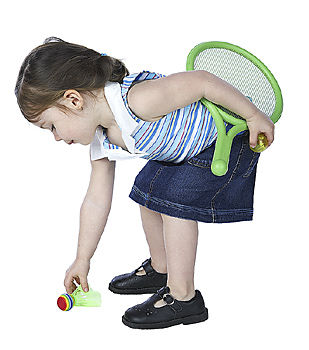 The word “exercise” brings to mind images of a reluctant kid on a treadmill, with a chastising parent in the background. This is part of the reason why it’s better to use the term “physical activity” instead of “exercise.” This wording is broader in scope and less unpleasant in its implications.
That said, I agree that it can be challenging to get big snowballs moving downhill, but once they get going things often become much easier. Moreover, keep in mind that if your child has a gym class or a sports related extracurricular activity he or she may already be engaging in a lot of physical activity. And, there are many easy ways to integrate more physical activity within your family life, as this download can illustrate.
All this said, some kids need a discipline plan to do well. For a brief overview of the relevant issues, click here; for a more detailed and specific discussion regarding strategies, see chapter five of my parenting book, Working Parents, Thriving Families.
#4 Kids need a lot of willpower to get recommended doses of physical activity.
I’m not a big fan of willpower as a primary tool for improving and supporting  adaptive health habits. For this reason. I think its important to minimize reliance on willpower whenever possible (e.g., see my blog entry on forming and keeping resolutions). That said, some degree of willpower is necessary for just about any worthwhile human endeavor. As psychologist Dr. Erich Fromm pointed out in his classic book The Art of Loving, if I do just about anything only when I feel like it, I will experience only compromised outcomes.
Fortunately, this month The American Psychological Association published useful survey research on willpower, together with a helpful list of self-help articles for strengthening and supporting it. For these resources, click here.
#5 Physical activity is fine, once required activities have been completed and we have the time for it.
When someone represents this thought I suspect that she or he has not been made aware of the research indicating the significant consequences that are associated with a lack of physical activity, even when a child is not overweight (see the next point). Moreover, physical activity can nicely break up a day that might otherwise be filled with high doses of duty and obligation (e.g., academics, chores). I wouldn’t say “nutrition is fine, once required activities have been completed and we have the time for it.” The same thing is true regarding my kid’s physical activity (and sleep).
 #6 The consequences of not being physically active only catch up with people in adulthood. So we have some time.
This is simply not true. Not only is obesity at risk (which comes with its own collection of adverse outcomes), but kids who are physically active have better moods, concentrate better, are more engaged with their families, have higher self-esteem, are socially more effective and are at reduced risk for an assortment of medical and psychiatric maladies. Indeed, being physically active is a primary resilience variable. This is why I focus on it in my parenting book as well as in my personal life (e.g., I’m a devotee of Tony Horton’s P90X programs, my three kids do a combination of 10 different sports activities throughout the year).
#7 This is hopeless. All I’ve tried has failed. I just need to live and let live when it comes to my child’s physical activity.
Hopelessness with this issue is never warranted, at least in every instance that has crossed my eye line. If you’re having these kinds of thoughts I’d recommend seeking out the services of a good child mental health professional. To find someone near you, click here.
Related blog articles not mentioned above:
Five Questions for Effectively Parenting Your Kid in Sports
Helping Your Child Get a Good Night’s Sleep
A Chronic Health Problem in Teens: A Lack of Sleep
I’ve been away for a bit. So, let’s get to it with the questions.
 Are elementary school children too young to be sending Valentine’s Day cards to each other?
This practice is usually both harmless and fun for kids. The only “rule” I might suggest is that if a teacher is going to allow V-Day cards/notes to be shared, I’d recommend that all kids be required to write a card/note for every kid in the classroom. This guideline is designed to avoid turning an otherwise fun event into a public display of a social pecking order. (Despite what the CEOs of greeting card companies might suggest, I also think the world would keep spinning if a teacher decided to not recognize V-day in his or her classroom.)
My teen wants to go out on a date on Valentine’s Day, but it’s a school night. What should I do?
I realize how intense a teen might lobby for such permission. Does this sound familiar: ”the choices for you, mom/dad, are to allow me to do this or to cast me into an abyss.” But, then again, so many of our teenager’s requests are couched in this way (says a man who lives with 2.0 of them, and will soon live with 3.0 of them).
The dramatic (for your teen) context not withstanding, I could envision scenarios where it would okay to allow this and others where it would not be. The more the following are true, the more I’d be inclined to allow it. The more the following are not true, the more I’d be inclined to say “no.”
√ Your teen is putting forth good effort in his or her academics and is judged to  be a good citizen by teachers.
√ You are comfortable with the circumstances of the date (e.g., where they are going, who they will be with and that they will sober, celibate and safe—see this blog entry for more on the latter).
√ The date will not interfere with your teen getting a good night’s sleep (see this blog entry for sleep guidelines).
My kid feels bad because s/he doesn’t have a boyfriend/girlfriend. What can I say?
I’m noticing that lots of teens, who do not have an official beau, are fine with that. But, if your teen is in distress about such, one of the things that can help is to share your own experiences of failure and pain when it comes to romance, especially if you can weave comedy into your stories (see this blog entry for a longer discussion on this).
Listen closely, though. Sometimes this discussion isn’t just about your teen not having a boyfriend or a girlfriend. Sometimes this discussion reflects a deeper problem with your teen’s self-esteem. Despite your best efforts, your teen may have serious doubts about his or her inherent value, not only as a romantic partner, but in general. While the first two chapters of my parenting book reviews specific strategies for promoting and enhancing a kid’s self esteem, if a teen feels this way I would err on the side of caution and seek out an evaluation from a good child mental health professional. (For a list of providers near you click here.)
 My teen wants to spend a lot of money on a Valentine’s Day present. What should I allow?
This is another complicated question that can be answered in different ways depending upon your unique situation. While I will probably write a future post elaborating on issues regarding training youth about money, here are some guidelines:
√ Does the amount of money involved, if spent on the gift, have the potential to be toxic? That is, does it significantly compromise some other important agenda (e.g., saving for a summer experience) or might it cause a deeper, and otherwise avoidable, sense of betrayal in the face of a subsequent break up?
√ Is the money involved the teen’s? That is money that s/he earned?
√ Is there a standing agreement between you and your teen regarding what monies s/he can spend as s/he wishes? It is highly advisable to form such agreements outside of such specific requests (i.e., in the context of a specific request most teen’s will regress and become difficult to reason with). Two factors to consider: what percentage is to be saved, either for college or otherwise? What percentage, if any, is to be given to charity?
Also remember, it is generally an insufficient reason to forbid a teen to do something if the only reason for forbidding it is that it makes you feel uncomfortable. One of our jobs as parents is to allow our teens to do things they want to do as long as such isn’t physically or psychologically harmful and doesn’t unduly tax our resources (i.e., time and money). For an expanded discussion on this click here.

My teen is interested in the same sex. How should I deal with that?
I would treat this no differently than you would if your teen was interested in the opposite sex. That is, I would allow no more, or no less, than would be healthy if your teen’s interests were heterosexual. Also, keep in mind that sexual interests fall along a complex continuum and that your teen’s interests can change over time. However, one of the things that can impair or unduly complicate this development is if a parent shames a teen’s emerging interests.
The one proviso I would offer, however, is that you discuss with your teen the safety of public displays of being a same-sex couple. There are circumstances where this can be dangerous, either in terms of psychological or physical consequences. A dispassionate case-by-case analysis of this danger can increase the odds that your teen will engage a path that is adaptive.
Please also keep in mind that I am answering this question as a psychologist whose only agenda is your teen’s mental health. In doing so I appreciate that you may have other agenda, such as adhering to the tenets of a religion you subscribe to. Should my counsel conflict with the latter, I recommend you meet with a qualified mental health professional to engage a pro-con analysis that considers all relevant factors (collateral counseling with a wise clergy person may also be indicated).
One final thought…
Here’s an extra tip thrown in for free: guys: always do something for your partner on V-Day, even if–and maybe even especially if–you’ve been told to not bother. Moreover, do so without an expectation of a response (e.g., gratitude, sex). This may be true for gals too, but sometimes it isn’t. But, for guys, it’s pretty much always true 😉

 Dr. David Palmiter's Blog for Hectic Parents